Original

Igbo names and spellings for various settlements
Abakaliki is Abankaleke; Afikpo is Ehugbo; Awgu is Ogu; Awka is Oka; Bonny is Ubani; Enugu is Enugwu; Ibusa is Igbuzö; Igrita is Igwuruta; Oguta is Ugwuta; Onitsha is Onicha; Owerri is Owere; Oyigbo is Obigbo... any more will be added.
Showing posts with label 1910s. Show all posts

Sunday, May 17, 2020

Bridge over Imo River

Bridge over Imo River. Published 1920. Internet Archive.

A temporary wooden bridge over the Imo River for the Eastern Division railway line built from 1913 to access the Udi coalfields around Enugwu Ngwo, terminating at the Diobu cliffs of the new port named Port Harcourt by Frederick Lugard. It was originally intended for the line to extend further north to Kaduna to join the Western Division railway to Kano, but the outbreak of WWI led to postponement. The work on the 151 mile section from the port to the Udi hills was prioritised due to the wartime need for coal.

Wednesday, May 13, 2020

Igbo compound walls

An Igbo compound entrance, in or near Önïcha. Photographed by Herbert Wimberley, c. 1903-18. Cambridge University Library.

The ancestral compound is usually handed down from father to first son, and other lands are shared by other sons, usually making concessions for daughters. There were compounds that were headed by women, especially in the case of wealthy women who married other women into their umunna (patriline), and there are Igbo communities such as Ohafia where agricultural land rights are traced matrilineally.

Sunday, May 3, 2020

Ùlì

An Igbo girl from Nibo, present-day Anambra State, with ùlì designs on her skin. Photographed by Northcote Thomas c. 1911. MAA Cambridge.

Friday, February 14, 2020

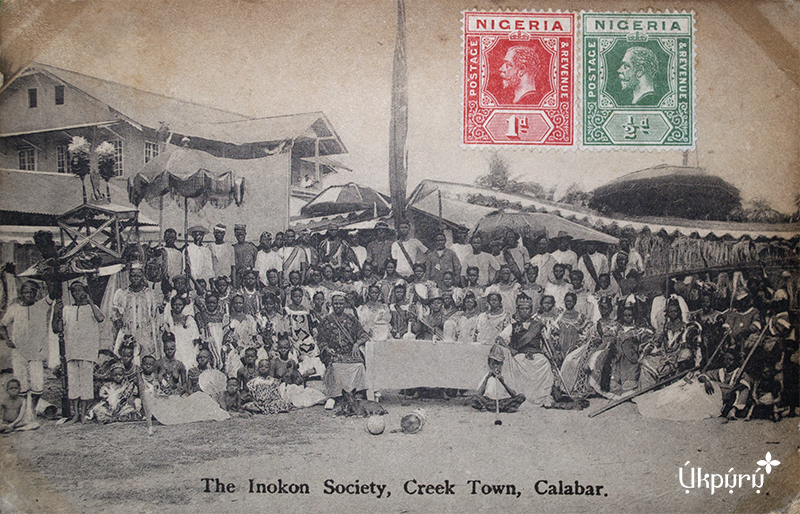
"Inokon"

"The Inokon Society, Creek Town, Calabar." Postcard from c. 1910s-20s. Ụ́kpụ́rụ́ Collection.

Inokon or Inokun may be related to Okon, a founding figure in the history of Arochukwu. It is the name the Aro people are known by in the Cross River area.

The Aros are often called Inokuns. Authorities disagree as to the difference between these names. It is stated that the Aros are the aristocratic or freeborn caste of the Inokun tribe, that there are sixteen Aro towns, each presided over by a chief of its own, and that these chiefs in united council used to govern the whole Inokun tribe. Of these sixteen towns, all in the near neighbourhood of the "Long Juju," the principal is Ibum [Ibom]. The Assistant District Commissioner used to live down in the town itself, but it was found to be damp and unhealthy, so the station was moved to the top of a hill about one and a half miles outside, previously occupied as an outlying farm of the township. Ibum is marked "Aro Chuku'' on the map, and the Government residence stands about midway between Aro Chuku and Obagu. From this hill one looks down upon the Aro towns, indicated in the densely wooded valley by the columns of blue smoke overhanging them.

Tuesday, February 4, 2020

Igbo Compound Tower

"An [Igbo] chief’s compound, with war-tower and inner wall; natives listening to phonograph; Azia, Onitsha district." A. E. Kitson, published 1913.

Each house stood in a compound surrounded by a high mud wall. There were small loop holes in the walls at equal distances, through which a gun could be fired in the event of an enemy attacking the town. In each compound also there was generally at least one high tree with a platform in its branches, from which a good lookout could be obtained. We noticed also two large, square watch-towers, three times the height of ordinary houses.

– T. J. Dennis (1899). Itineration in the Ibo Country. p. 780.

Saturday, December 7, 2019

Eze Ede

Ndị Ngwa, around Aba, photographed by Northcote Thomas, c. 1913. MAA Cambridge.

In the Igbo area, in southern parts especially (Abia, Imo, Rivers), women who are highly successful in farming cocoyams take on the Eze Ede, king of cocoyams, or Ikwa Ede title. Eze Ede become the spokespeople for women in the community. Women with even larger mkpuke ede, cocoyam stores, are initiated with the title of Ezumezu. In some communities, the title associated with women's cocoyam farming is referred to as Lọlọ Ede.

Exemplarily of the dualistic nature of Igbo society, Eze Ede is the female counterpart to a major title for men, the Eze Ji title, king of yams, given to successful farmers with large yam barns. Other similar titles are the Diji and Duru Ji titles. Yams are traditionally cultivated by men, cocoyams are the spiritual and folkloric female equivalent of yams.

Monday, December 2, 2019

Ebonyi

The Ebonyi River from a photo album made before the 1920s. The National Archives UK.

The Igbo people who passed and lived around the Ebonyi River were part of a great expansionist Igbo group that mostly sprang out of an initial migration over the Imo from the Mbano area. The groups, including the Izi, Eza, Ikwo, and Mgbo, were large militaristic groups who were able to overtake the lands of several Upper Cross River groups over the last couple of hundred years.

Sunday, November 24, 2019

Enuani Lady

A young Igbo woman from Onicha Olona, or surrounding settlement, c. 1912-13. Onicha Olona is an Enuani settlement, an Igbo population west of the Niger River. Many of these settlements were founded by migrations from east of the Niger River (Oshimili) hundreds of years ago. These settlements came into much contact with the Edo and Igala. The Benin Empire especially influenced their political structures and even populations, particularly after the conquering 15th century Oba, Oba Ewuare.

Wednesday, November 20, 2019

Igbo Landscaping and Architecture

A building photographed in the western Igbo area, filed under Onicha Olona by the MAA Cambridge, but may be another surrounding Igbo town. The trees and shrubs appear to have been planted in an order. Photographed by Northcote Thomas and assistants, c. 1912-13.

Wednesday, November 6, 2019

Ezeani Obidigbo of Neni

"Chief Obudugbo. Ezeana of Neni" [Ezeani Obidigbo of Ugwudunu, Neni?]. Photographed by Northcote Thomas, c. 1910-11. MAA Cambridge.

The keepers of Ani (Ala), the shrine of the Earth Mother, are usually the autochthonous section of a community, a group that can trace their patriline to the original settlers of a community. Ndị nwe Ànà are the highly respected and revered spiritual leaders of a community due to the supremacy of Ani in Igbo society. To keep the Ani is to keep the laws of the land.

Various communities have their own personal Ani because of their unique relationships with Ani and the work in setting up the shrine.

Sunday, October 13, 2019

Òmenàlà

Symbol of Ala, the Earth Mother, among the Eda Igbo, present-day Abia or Ebonyi State. P. A. Talbot, c. 1920s.

Most Igbo people in the past did not perceive themselves as belonging to a religion. The split between culture and religion did not exist. All practices were viewed as duty. This view of duty, compulsory rites that place tradition and service and reverence to ancestors over belief itself, still exists in the kola nut rite, ịche ọjị, for example, which could've been classed as a religious rite.

Sunday, August 11, 2019

Ọ̀gbọ Agha

Ọ̀gbọ agha. A war demonstration by men whose names do not appear to have been noted, photographed by Northcote Thomas, c. 1910-11. The men have swords/machetes, shields made from either wood or the 'midrib of oil palms', and war hats. The location is given as Awka. Colourised Ụ́kpụ́rụ́ 2019. MAA Cambridge.

Original.

Thursday, July 18, 2019

Omu Okpanam

The Omu of Okpanam, whose name was not recorded, photographed by Northcote Thomas in 1912. Okpanam is an Enuani Igbo town near Asaba in Delta State, Nigeria today.

The Omu are titled women who control markets and are spiritual protectors to the Obi, the king, in Igbo communities west of the Niger River, typically among the Enuani, and in the past in Onicha (Onitsha) and Osomari on the east bank of the Niger River. There is one Omu in each community with the institution.

The Omu work closely with diviners performing rites for the community and are the authorities over the opening of markets and resolving disputes within the market. The Omu depending on the community and period take titles typically reserved for men and also dress like men, as a consequence women who are post-menopausal are preferred for the role because such women in Igbo society could achieve the same status as men. As is custom in most communities, the Omu was not allowed to be married to a man, Omu were known to marry wives to assist them and have children for them.

Colonialism greatly reduced the power of the Omu in the market and over society in general due to gender bias in the indirect rule system, colonialism was also partly the cause of the disappearance of the institution in some Igbo communities. Today there are many Omu who are still active in their roles.
Friday, July 5, 2019

Igbo hair

Women's hairstyles from different Igbo groups sketched by P. A. Talbot in or before the 1920s.

Sunday, May 19, 2019

Omambara

Crossing the Omambara River (or ‘Anambra River’) at Ogurugu in present day Uzo-Uwani LGA, Enugu State, Nigeria, c. 1916. Photo: Hugh Nevin Nevins.

Friday, May 3, 2019

Ùlì Ǹrì

An Igbo man from Agukwu Nri decorated with what appears to be ùlì, a semi-permanent dye from a plant and a system of symbols of the same name. Photographed by Northcote Thomas, c. 1910-11. MAA Cambridge.

Saturday, March 9, 2019

Owere Woman

A woman from Owere (Owerri) photographed by Northcote Thomas, c. 1912-13. Her name (or at least an approximation) may have been recorded in Northcote Thomas' photographic register. MAA Cambridge. Her wrapper is similar to Akwete textile designs.

Sunday, March 3, 2019

Elder Efuome of Ezi Öka

"Chief Efuome of Ezi Awka," photographed by Northcote Thomas and assistants, 1910-11. In the elder's hand is ngwụ agịlịga and elili Ọzọ (or owu Ọzọ) on his ankles which is for ndị Nze (titled men). In the elder's hat are probably ugo (fish eagle) feathers.

Tuesday, January 29, 2019

Nwauko

An Igbo girl photographed in Nibo and noted as ‘Nwauko’ in Northcote Thomas’ photographic register, c. 1910-11.

Thursday, December 27, 2018

Ögbü Compound

Ögbü (Awgbu), p.d. Anambra State, what was described as a store house by Northcote Thomas, tower in the background, May 1911. Part of Thomas’ British colonial government backed anthropological tour of the north-central Igbo-speaking area.