Original

Igbo names and spellings for various settlements
Abakaliki is Abankaleke; Afikpo is Ehugbo; Awgu is Ogu; Awka is Oka; Bonny is Ubani; Enugu is Enugwu; Ibusa is Igbuzö; Igrita is Igwuruta; Oguta is Ugwuta; Onitsha is Onicha; Owerri is Owere; Oyigbo is Obigbo... any more will be added.
Showing posts with label Igbo. Show all posts

Monday, July 6, 2020

People

Two women who are most likely Igbo and from the Önïcha area judging by the presence of the Obi Önïcha in related photos. Photographed by Herbert Wimberley, c. 1903-18. Cambridge University Library.

The pair posing with a man with a staff in the middle that looks to be a staff for men who hold the ǹzè title (alọ̀).

Monday, June 29, 2020

Aja Ǹgwùlù

Igbo compound (ǹgwùlù) entrance and high walls (aja ǹgwùlù), in or near Önïcha. Photographed by Herbert Wimberley, c. 1903-18. Cambridge University Library.

Ụ̀dị ndị 'ọ̀ ka ibè ya' (I pass my neighbour).

A Lady of Ụgwụtā wearing Ivory

A woman of Ügwüta, Òru area, early 20th century. Internet Archive. Òru, riverine Igbo around the Niger, were known for their markets by waterways, the highways of trade. Wealthy traders made up exclusive title societies and wore ivory armlets and anklets. The ivory was traded long-distance.

Saturday, May 23, 2020

Arụ̀ Women

Aro women photographed by Rev. William T. Weir, in The Women's Missionary Magazine of the United Free Church of Scotland, 1904. Google digitisation.

Wednesday, May 20, 2020

Dike Nwaàmị̀ Ọ̀hafị̄ā

Ohafia women with long braids fashionable in Ohafia at the time. Photographed by Rev. William T. Weir. From The Women's Missionary Magazine of the United Free Church of Scotland, 1904. Google digitisation.

Ohafia is a society where rights to farmlands are passed through the maternal line and where there were women, although rare, who joined the usually male Ekpè society. A number of Ohafia women warriors, dike nwaàmị̀, local and married into Ohafia, are recorded in the history and folktales of Ohafia. A version of one particular story tells of Nne Mgbaafo who, in war gear, risked her life looking for her husband who she thought was killed by enemies in Ibibio territory. Putting her life on the line, Nne Mgbaafo's intimidation of the enemies led to them revealing that her husband had in fact been kidnapped and, through her bravery, she was able to take him back to Ohafia.
Saturday, May 16, 2020

Ọ̀kọ̀nkọ̀ Tolls

An Ekpe masquerader in Uzuakoli, present-day Abia State. Photographed by G. I. Jones, 1930s. MAA Cambridge.

Ọ̀kọ̀nkọ̀ members controlled important roads in the eastern Igbo area. British imperial interests ran against this system.

Passing by Abruki, which had, however, to be " dashed " in the usual way, we arrived in the evening at Omo-pra [Ụmụ̀ọpara?], the last mile or two into the town being more like an avenue in England, shaded by splendid trees, than a wild roadway in Africa. […] Under a lowering sky, and in a, slight drizzle of rain, we left Omo-pra early the next morning[.]

"A Famous Were-Leopard"

"A Famous Were-Leopard". Percy Amaury Talbot. Internet Archive.
The power of metamorphosis is generally termed Uworraw-Ukponn, corresponding to the Ibo word Ehihi, and is sometimes inherited, sometimes bought. Since many believe that it is only used for evil purposes, the faculty is not often boasted of, or admitted, by its possessor. Nearly all " strong " animals in the bush, such as leopards, elephants, etc., are credited with being were-beasts, but such can only be recognised by hunters, who, unless bad men, would not shoot them, since their death would entail that of their affinity.

Wednesday, May 13, 2020

Igbo compound walls

An Igbo compound entrance, in or near Önïcha. Photographed by Herbert Wimberley, c. 1903-18. Cambridge University Library.

The ancestral compound is usually handed down from father to first son, and other lands are shared by other sons, usually making concessions for daughters. There were compounds that were headed by women, especially in the case of wealthy women who married other women into their umunna (patriline), and there are Igbo communities such as Ohafia where agricultural land rights are traced matrilineally.

Tuesday, May 12, 2020

Prince Chukwuma of Àbọ, William Baikie

"Prince Tshúkuma [Chukwuma]" of Abö, illustration from an 1854 voyage by William Baikie. Internet Archive.
[At Abö] we learnt that King Obí [Osai] had been dead for nearly nine years, and that since that time there had been no regular king. At Abó, the chief power is elective, and after the death of Obí two parties sprung up, one of which supported the claims of his son, while the other advanced as their candidate an influential person named Orísa. The two sections were respectively entitled the king's people and the Oshiodápara party. Obí's friends were unanimous in their selection of Obí's second son, named Ajé, an active, intelligent, young man ; and this was acquiesced in by his less energetic and more peaceful brother Okúrobi or Tshúkuma.

Thursday, May 7, 2020

A Lady of Nibo

An Igbo woman from Nibo, present-day Anambra State. Photographed by Northcote Thomas c. 1911. MAA Cambridge.

Wednesday, May 6, 2020

'The King of the Eboes'

People on the island of Jamaica. USC Digital Library.

March 22, 1816. A European's account of a thwarted African uprising in Jamaica.

The two ringleaders of the proposed rebellion at St. Elizabeth's have been condemned, the one to be hanged, the other to be transported. The plot was discovered by the overseer of Lyndhurst Penn (a Frenchman from St. Domingo) observing an uncommon concourse of stranger negroes at a child's funeral, on which occasion a hog was roasted by the father. […] They had elected a King of the Eboes [Igbo], who had two Captains under him;

Sunday, May 3, 2020

Ùlì

An Igbo girl from Nibo, present-day Anambra State, with ùlì designs on her skin. Photographed by Northcote Thomas c. 1911. MAA Cambridge.

Sunday, April 26, 2020

Aro Sword

Double edged sword with a fluted blade from Arochukwu, c. 1932 or earlier. Pitt Rivers Museum [+].

Sunday, April 12, 2020

The Okoli Ijeoma Ada War: Agha Ìbenne

Gịnị mè ndị Ọka jì à sọ ènwè?


Enwe Imoka, the mona, Porto-Novo, Benin. Photo: Okouneva Olga via Wikimedia Commons.

Background

Okoli Ijeoma was a 19th-century merchant warlord of the Aro settlement of Ndikelionwu in today’s Anambra State. He was notorious for his recruitment of the militaristic Ada people of the Cross River area for wars against his enemies or for the services of those who paid him. He was the grandson of Ikelionwu who founded Ndikelionwu in the 18th century.

Sunday, March 8, 2020

Òtù Ọdụ

"Rich Women. Onitsha. (church members.)" G. F. Packer, 1880s. Pitt Rivers Museum.

These women are likely part of the Ndị Ọdụ, Òtù Enyi, or Òtù Ọdụ society, the ivory society, the elite women’s socio-political and economic organisation of the Önïcha (Onitsha) ministate made up of wealthy members who either bought the rights to the title or whose relatives bought the rights to either wear ọdụ aka, ivory bracelets, or ọdụ ụkwụ, ivory anklets, or both.

Friday, February 14, 2020

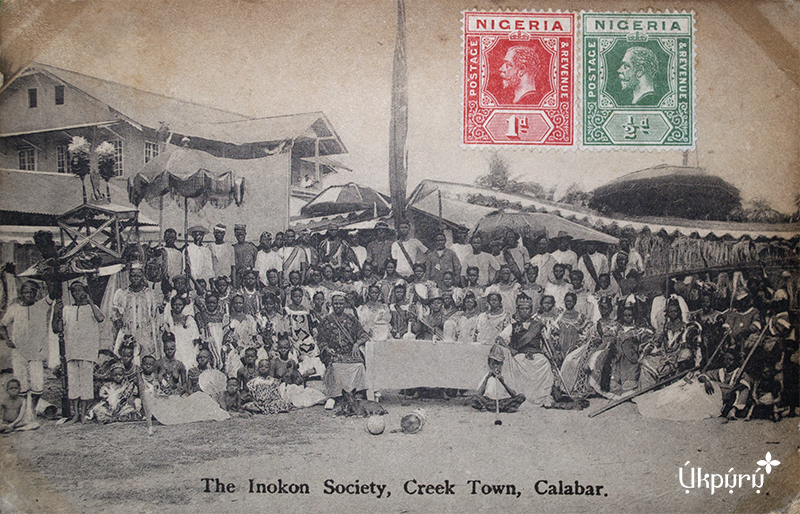
"Inokon"

"The Inokon Society, Creek Town, Calabar." Postcard from c. 1910s-20s. Ụ́kpụ́rụ́ Collection.

Inokon or Inokun may be related to Okon, a founding figure in the history of Arochukwu. It is the name the Aro people are known by in the Cross River area.

The Aros are often called Inokuns. Authorities disagree as to the difference between these names. It is stated that the Aros are the aristocratic or freeborn caste of the Inokun tribe, that there are sixteen Aro towns, each presided over by a chief of its own, and that these chiefs in united council used to govern the whole Inokun tribe. Of these sixteen towns, all in the near neighbourhood of the "Long Juju," the principal is Ibum [Ibom]. The Assistant District Commissioner used to live down in the town itself, but it was found to be damp and unhealthy, so the station was moved to the top of a hill about one and a half miles outside, previously occupied as an outlying farm of the township. Ibum is marked "Aro Chuku'' on the map, and the Government residence stands about midway between Aro Chuku and Obagu. From this hill one looks down upon the Aro towns, indicated in the densely wooded valley by the columns of blue smoke overhanging them.

Wednesday, February 12, 2020

Àbọ House

"Eboe House", a drawing on the map of the Niger River by the Lander Brothers while on their expedition of the Niger River in 1830. via archive.org.
The little we could see of the houses with which the shore is interspersed gave us a very favourable impression of the judgment and cleanliness of the inhabitants of the town. They are neatly built of yellow clay, plastered over, and thatched with palm-leaves; yards sprucely fenced are annexed to each of them, in which plantains, bananas, and cocoa-trees grow, exhibiting a pleasing sight, and affording a delightful shade.

– The Lander Brothers, 1832. From Journal of an Expedition to Explore the Course and Termination of the Niger. Vol. II, p. 210.

Àbọ Canoe

"Eboe Canoe." An Abö canoe via the Lander Brothers while on their expedition of the Niger River in 1830. via archive.org.
An hour or two after this, or about midday, one of the Eboe men in our canoe exclaimed, “There is my country!” pointing to a clump of very high trees, which was yet at some distance before us; and after passing a low fertile island, we quickly came to it. Here we observed a few fishing-canoes, but their owners appeared suspicious and fearful, and would not come near us, though their national flag, which is a British Union, sewed on a large piece of plain white cotton with scallops of blue, was streaming from a long staff in the bow. The town was yet, we were told, a good way down the river. In a short time, however, we came to an extensive morass, intersected by little channels in every direction, and by one of these we got into clear water, in front of the Eboe town. Here we found hundreds of canoes, some of them even larger than any we had previously met with. They are furnished with sheds and awnings, and afford commodious habitations for a vast number of people, who constantly reside in them; perhaps one of these canoes, which is made of a single trunk, contains as many as seventy individuals.

– The Lander Brothers, 1832. From Journal of an Expedition to Explore the Course and Termination of the Niger. Vol. II, p. 210.

Igbo Runaways

Igbo 'runaways' in Jamaica on a page of The Royal Gazette, a 19th c. newspaper. Runaways escaped slavery for freedom. This is from a list of those caught c. 1826. These people were born in the Igbo country and taken over the Atlantic to the West Indies. University of Southampton.

Thursday, February 6, 2020

Àbọ

"The Aboh Creek", drawn from an 1841 visit during the British government's Niger Expedition.

Abö (Àbọ) was the most powerful mercantile state on the Lower Niger before European incursion into these hinterland areas around the Niger.

Located directly on the western bank of the Niger River, near the Forcados and Nun rivers from which the Niger runs into the Atlantic, Abö controlled trade on the Niger from the delta areas up to Asaba, with its influence reaching Ida, the Igala capital and main trading rival of Abö.