Original

Igbo names and spellings for various settlements
Abakaliki is Abankaleke; Afikpo is Ehugbo; Awgu is Ogu; Awka is Oka; Bonny is Ubani; Enugu is Enugwu; Ibusa is Igbuzö; Igrita is Igwuruta; Oguta is Ugwuta; Onitsha is Onicha; Owerri is Owere; Oyigbo is Obigbo... any more will be added.
Showing posts with label Crowds. Show all posts

Monday, July 6, 2020

People

Two women who are most likely Igbo and from the Önïcha area judging by the presence of the Obi Önïcha in related photos. Photographed by Herbert Wimberley, c. 1903-18. Cambridge University Library.

The pair posing with a man with a staff in the middle that looks to be a staff for men who hold the ǹzè title (alọ̀).

Sunday, May 17, 2020

Bridge over Imo River

Bridge over Imo River. Published 1920. Internet Archive.

A temporary wooden bridge over the Imo River for the Eastern Division railway line built from 1913 to access the Udi coalfields around Enugwu Ngwo, terminating at the Diobu cliffs of the new port named Port Harcourt by Frederick Lugard. It was originally intended for the line to extend further north to Kaduna to join the Western Division railway to Kano, but the outbreak of WWI led to postponement. The work on the 151 mile section from the port to the Udi hills was prioritised due to the wartime need for coal.

Saturday, May 16, 2020

Ọ̀kọ̀nkọ̀ Tolls

An Ekpe masquerader in Uzuakoli, present-day Abia State. Photographed by G. I. Jones, 1930s. MAA Cambridge.

Ọ̀kọ̀nkọ̀ members controlled important roads in the eastern Igbo area. British imperial interests ran against this system.

Passing by Abruki, which had, however, to be " dashed " in the usual way, we arrived in the evening at Omo-pra [Ụmụ̀ọpara?], the last mile or two into the town being more like an avenue in England, shaded by splendid trees, than a wild roadway in Africa. […] Under a lowering sky, and in a, slight drizzle of rain, we left Omo-pra early the next morning[.]

Wednesday, May 6, 2020

'The King of the Eboes'

People on the island of Jamaica. USC Digital Library.

March 22, 1816. A European's account of a thwarted African uprising in Jamaica.

The two ringleaders of the proposed rebellion at St. Elizabeth's have been condemned, the one to be hanged, the other to be transported. The plot was discovered by the overseer of Lyndhurst Penn (a Frenchman from St. Domingo) observing an uncommon concourse of stranger negroes at a child's funeral, on which occasion a hog was roasted by the father. […] They had elected a King of the Eboes [Igbo], who had two Captains under him;

Friday, April 17, 2020

Palm Oil

A palm oil factory photographed by Jonathan Adagogo Green likely in either Opobo or Bonny, c. late 19th century. British Museum.

The palm oil industry grew after the sixteenth century as a provisional source for the growing international and slave trade. After the palm oil industry replaced the slave trade from roughly around the 1840s, the southern Igbo area became the biggest producer of palm oil in the world by the 19th century, accounting for over one-third of West African palm oil exports by the colonial era. Palm oil also dominated the economies of other areas of the Niger Delta, such as the Urhobo and Isoko areas.

Saturday, March 14, 2020

Shrine to Agwụ̀

Titled elder Onyeso of Agukwu Nri washing hands for a rite before a shrine to Agwụ̀, a divinity of doctors (dibị̀à). Photographed by Northcote Thomas in 1911. MAA Cambridge.

Agwụ̀ is an entity of unconventionality and hence creativity that guides the dibị̀à. Agwụ̀ is related to strange occurrences and mishaps. Such occurrences are often signs to individuals that are destined to become doctors.

Sunday, March 8, 2020

Òtù Ọdụ

"Rich Women. Onitsha. (church members.)" G. F. Packer, 1880s. Pitt Rivers Museum.

These women are likely part of the Ndị Ọdụ, Òtù Enyi, or Òtù Ọdụ society, the ivory society, the elite women’s socio-political and economic organisation of the Önïcha (Onitsha) ministate made up of wealthy members who either bought the rights to the title or whose relatives bought the rights to either wear ọdụ aka, ivory bracelets, or ọdụ ụkwụ, ivory anklets, or both.

Friday, February 14, 2020

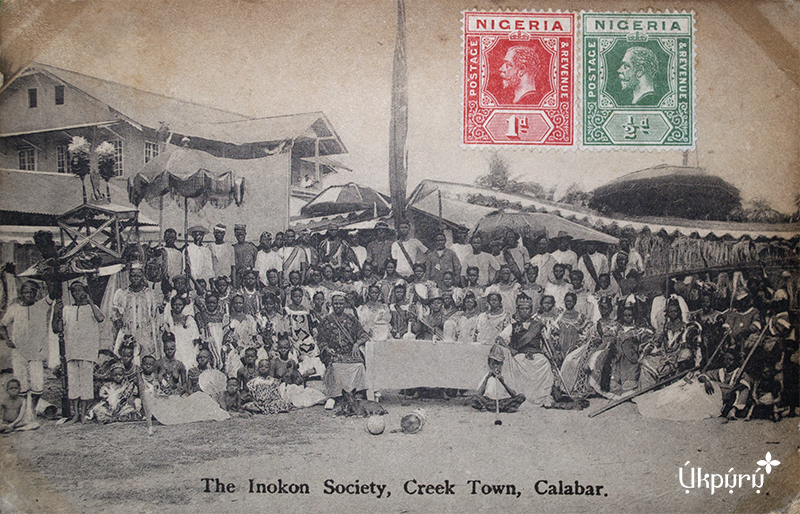
"Inokon"

"The Inokon Society, Creek Town, Calabar." Postcard from c. 1910s-20s. Ụ́kpụ́rụ́ Collection.

Inokon or Inokun may be related to Okon, a founding figure in the history of Arochukwu. It is the name the Aro people are known by in the Cross River area.

The Aros are often called Inokuns. Authorities disagree as to the difference between these names. It is stated that the Aros are the aristocratic or freeborn caste of the Inokun tribe, that there are sixteen Aro towns, each presided over by a chief of its own, and that these chiefs in united council used to govern the whole Inokun tribe. Of these sixteen towns, all in the near neighbourhood of the "Long Juju," the principal is Ibum [Ibom]. The Assistant District Commissioner used to live down in the town itself, but it was found to be damp and unhealthy, so the station was moved to the top of a hill about one and a half miles outside, previously occupied as an outlying farm of the township. Ibum is marked "Aro Chuku'' on the map, and the Government residence stands about midway between Aro Chuku and Obagu. From this hill one looks down upon the Aro towns, indicated in the densely wooded valley by the columns of blue smoke overhanging them.

Tuesday, February 4, 2020

Igbo Compound Tower

"An [Igbo] chief’s compound, with war-tower and inner wall; natives listening to phonograph; Azia, Onitsha district." A. E. Kitson, published 1913.

Each house stood in a compound surrounded by a high mud wall. There were small loop holes in the walls at equal distances, through which a gun could be fired in the event of an enemy attacking the town. In each compound also there was generally at least one high tree with a platform in its branches, from which a good lookout could be obtained. We noticed also two large, square watch-towers, three times the height of ordinary houses.

– T. J. Dennis (1899). Itineration in the Ibo Country. p. 780.

Monday, December 16, 2019

The road from Ụgwụtā to Òwèrè, c. 1909

The road from Ụgwụtā (Oguta) to Owere (Owerri), c. 1909, showcasing the undulating landscape of the Igbo country.

Whether this is a ‘pre-colonial’ road or not is not specified, but this could be how trade routes were in the past.

Nigeria, 1932 [cropped]. Library of Congress.

The Igbo area is one of the most densely populated areas in the world. Relative stability over centuries made it so. Developmentally, it may turn into one metropolitan area, with considerations for nature and the environment.

Saturday, December 14, 2019

Government School, Owerri District, c. 1909

Government School, Owerri District, c. 1909.

Colonial Home, Enugwu

Home of a member of the British colonial establishment, Enugu. Staged photo, 1930s(?). The people standing are named, from left: Adebayo, Kanu(?), unnamed person(?), Thomas, two "gardeners," an unnamed person, and a "cook" on the right.

In all contact with the natives, let your first thought be the preservation of your own dignity. The natives are accustomed to dealing with very few white people and those they meet hold positions of authority. The British are looked up to, put on a very high level. Don't bring that level down by undue familiarity.

– WWII instructions given to white troops stationed in West Africa. From the West African Review, January 1943.

Saturday, December 7, 2019

Eze Ede

Ndị Ngwa, around Aba, photographed by Northcote Thomas, c. 1913. MAA Cambridge.

In the Igbo area, in southern parts especially (Abia, Imo, Rivers), women who are highly successful in farming cocoyams take on the Eze Ede, king of cocoyams, or Ikwa Ede title. Eze Ede become the spokespeople for women in the community. Women with even larger mkpuke ede, cocoyam stores, are initiated with the title of Ezumezu. In some communities, the title associated with women's cocoyam farming is referred to as Lọlọ Ede.

Exemplarily of the dualistic nature of Igbo society, Eze Ede is the female counterpart to a major title for men, the Eze Ji title, king of yams, given to successful farmers with large yam barns. Other similar titles are the Diji and Duru Ji titles. Yams are traditionally cultivated by men, cocoyams are the spiritual and folkloric female equivalent of yams.
Friday, December 6, 2019

Onye Ọcha

Onye Ọcha mask, Igbo parody of a white man during the colonial era from Amobia, part of a larger play. Apart from more serious ritual masks, a key part of many Igbo masquerading festivals are comedic and satirical masks. G. I. Jones, 1930s. MAA Cambridge. [Consider the photographer.]

Ghost policemen masks, symbols of colonial powers, part of the same masquerade play as the Oyibo or Onye Ọcha mask from Amobia. G. I. Jones, 1930s. MAA Cambridge.

Monday, November 11, 2019

Ndị Ìgbò

An unidentified group portrait taken by a Royal Niger Company employee c. 1886 - 1895. Based on other photos, these could be people from the Asaba or Önïcha area. MAA Cambridge.

Sunday, October 27, 2019

Ụ̀banị̀

"Water play Bonny For Oko Jumbo" – Jonathan Adagogo Green (Ibani photographer). 1895-1905. British Museum.

Bonny was a powerful coastal state and major port during the slave and palm oil trade. Bonny, Ibani, known as Ụ̀banị̀ in the Igbo interior, set on trading expeditions into the creeks with dozens of canoes holding up to 120 people each. During the slave trade, a group of Bonny slaving canoes could reportedly carry back up to 2000 people from the interior. The creeks were major highways for trade. The Ụ̀banị̀ people brought European cloth and other goods such as gin, pomade, and other European-made drinks to the traders in the interior.

Friday, October 25, 2019

Ụ̀kwà

"At the Akquete [Akwete] Market" by Jonathan Adagogo Green, an Ibani (Bonny) photographer, 1895-1905. British Museum. The Ndoki (which Akwete is a part), Asa, and Omuma area is collectively referred to as Ụ̀kwà, which apparently means wealth.

Before the 20th century, this area was a major market area including the Ohambele, Ohanku, Azumini, and Akwete markets that served as meeting points for Igbo groups and coastal middlemen, especially the Ubani or Ibani (of Bonny Island) who brought up European goods to be traded.

Sunday, October 13, 2019

Òmenàlà

Symbol of Ala, the Earth Mother, among the Eda Igbo, present-day Abia or Ebonyi State. P. A. Talbot, c. 1920s.

Most Igbo people in the past did not perceive themselves as belonging to a religion. The split between culture and religion did not exist. All practices were viewed as duty. This view of duty, compulsory rites that place tradition and service and reverence to ancestors over belief itself, still exists in the kola nut rite, ịche ọjị, for example, which could've been classed as a religious rite.

Tuesday, August 27, 2019

Agbọọ mmụọ

Agbọ mmụọ, Igbo maiden spirit masks, early 20th century. These masks are worn by men and the design of the costumes incorporate the cosmetics, ornaments, and dress of women in the community. Their outing brings a balance of femininity to masquerade festivals. They play a role in the veneration of the Earth Mother through their appearance at festivals.

Sunday, August 11, 2019

Ọ̀gbọ Agha

Ọ̀gbọ agha. A war demonstration by men whose names do not appear to have been noted, photographed by Northcote Thomas, c. 1910-11. The men have swords/machetes, shields made from either wood or the 'midrib of oil palms', and war hats. The location is given as Awka. Colourised Ụ́kpụ́rụ́ 2019. MAA Cambridge.

Original.