Original

Igbo names and spellings for various settlements
Abakaliki is Abankaleke; Afikpo is Ehugbo; Awgu is Ogu; Awka is Oka; Bonny is Ubani; Enugu is Enugwu; Ibusa is Igbuzö; Igrita is Igwuruta; Oguta is Ugwuta; Onitsha is Onicha; Owerri is Owere; Oyigbo is Obigbo... any more will be added.
Showing posts with label The Upper Class. Show all posts

Tuesday, May 12, 2020

Prince Chukwuma of Àbọ, William Baikie

"Prince Tshúkuma [Chukwuma]" of Abö, illustration from an 1854 voyage by William Baikie. Internet Archive.
[At Abö] we learnt that King Obí [Osai] had been dead for nearly nine years, and that since that time there had been no regular king. At Abó, the chief power is elective, and after the death of Obí two parties sprung up, one of which supported the claims of his son, while the other advanced as their candidate an influential person named Orísa. The two sections were respectively entitled the king's people and the Oshiodápara party. Obí's friends were unanimous in their selection of Obí's second son, named Ajé, an active, intelligent, young man ; and this was acquiesced in by his less energetic and more peaceful brother Okúrobi or Tshúkuma.

Sunday, March 8, 2020

Òtù Ọdụ

"Rich Women. Onitsha. (church members.)" G. F. Packer, 1880s. Pitt Rivers Museum.

These women are likely part of the Ndị Ọdụ, Òtù Enyi, or Òtù Ọdụ society, the ivory society, the elite women’s socio-political and economic organisation of the Önïcha (Onitsha) ministate made up of wealthy members who either bought the rights to the title or whose relatives bought the rights to either wear ọdụ aka, ivory bracelets, or ọdụ ụkwụ, ivory anklets, or both.

Friday, February 14, 2020

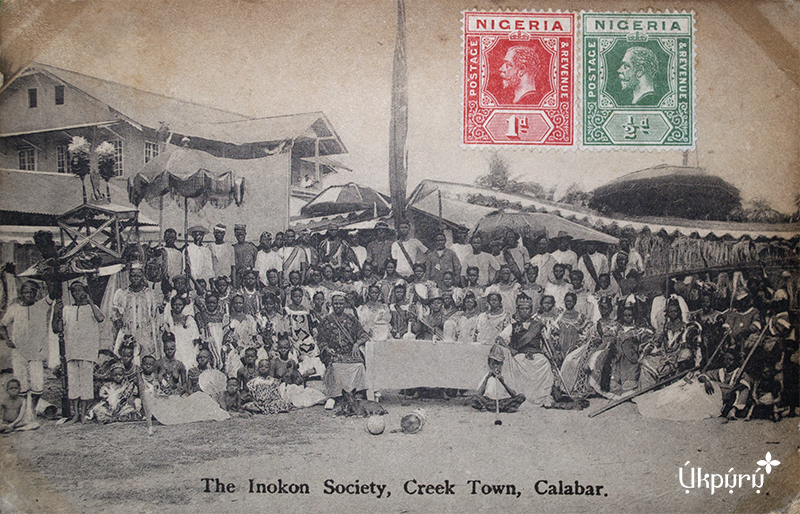
"Inokon"

"The Inokon Society, Creek Town, Calabar." Postcard from c. 1910s-20s. Ụ́kpụ́rụ́ Collection.

Inokon or Inokun may be related to Okon, a founding figure in the history of Arochukwu. It is the name the Aro people are known by in the Cross River area.

The Aros are often called Inokuns. Authorities disagree as to the difference between these names. It is stated that the Aros are the aristocratic or freeborn caste of the Inokun tribe, that there are sixteen Aro towns, each presided over by a chief of its own, and that these chiefs in united council used to govern the whole Inokun tribe. Of these sixteen towns, all in the near neighbourhood of the "Long Juju," the principal is Ibum [Ibom]. The Assistant District Commissioner used to live down in the town itself, but it was found to be damp and unhealthy, so the station was moved to the top of a hill about one and a half miles outside, previously occupied as an outlying farm of the township. Ibum is marked "Aro Chuku'' on the map, and the Government residence stands about midway between Aro Chuku and Obagu. From this hill one looks down upon the Aro towns, indicated in the densely wooded valley by the columns of blue smoke overhanging them.

Sunday, December 1, 2019

The Western-style school established in 1870s Opobo

Photo: King Jaja of Opobo, The New York Public Library.

The Western-style school established in 1870s Opobo by King Jaja and other Africans before British colonisation.

The aspect of modernization that deeply interested Jaja was the acquisition of secular education, which he considered essential if his people were to profit from their commercial enterprise. Because he could barely read and write he had to employ a private secretary, a Sierra Leonean known as D. C. Williams, who became responsible for maintaining his correspondence with the British. In 1873 Jaja sponsored the opening of a school at Opobo with another Sierra Leonean, Mr. Gooding, as the teacher. Twelve years later the population of this school stood at sixty boys and girls, under the instruction of an American Black woman, Emma Johnson. According to one visitor, the standard of education attained by the children was comparable to that of English children of the same age.

– Sylvanus John Sodienye Cookey (1974). “King Jaja of the Niger Delta: His Life and Times, 1821-1891.”

Thursday, July 18, 2019

Omu Okpanam

The Omu of Okpanam, whose name was not recorded, photographed by Northcote Thomas in 1912. Okpanam is an Enuani Igbo town near Asaba in Delta State, Nigeria today.

The Omu are titled women who control markets and are spiritual protectors to the Obi, the king, in Igbo communities west of the Niger River, typically among the Enuani, and in the past in Onicha (Onitsha) and Osomari on the east bank of the Niger River. There is one Omu in each community with the institution.

The Omu work closely with diviners performing rites for the community and are the authorities over the opening of markets and resolving disputes within the market. The Omu depending on the community and period take titles typically reserved for men and also dress like men, as a consequence women who are post-menopausal are preferred for the role because such women in Igbo society could achieve the same status as men. As is custom in most communities, the Omu was not allowed to be married to a man, Omu were known to marry wives to assist them and have children for them.

Colonialism greatly reduced the power of the Omu in the market and over society in general due to gender bias in the indirect rule system, colonialism was also partly the cause of the disappearance of the institution in some Igbo communities. Today there are many Omu who are still active in their roles.

Saturday, June 1, 2019

The Peopling of Ikot Ishie, an Igbo Diasporic Town of Calabar

Photo: "The Calaba and Opobo people at the show, Lagos," 1909 postcard.
[Ikot Ishie, Calabar] was named after Ishie Offiong Okoho, an Igbo ex-slave of Chief Offiong Okoho of Archibong House in Duke Town[.] […] Oral tradition maintains that Ishie, an Igbo slave, was bought as a youth and grew up in his masters' household. He was adopted and acquired the name Offiong Okoho from his master, Chief Offiong Okoho. […] Having served his master faithfully, Ishie Offiong Okoho was manumitted and was allocated the whole expanse of land (consisting of Ikot Ishie area) to live and prosper on his own.

[Apparently, Ishie Offiong Okoho also became a wealthy trader during the slave trade era, obtaining his slaves from the interior of the Igbo area to his domain of Ikot Ishie.]

Photo: "Government Hill from Duketown, Old Calabar," 1903 postcard.
Beside the present Bassey Duke, Bedwell, Chamley and Nelson Mandela axis, Ikot Ishie has the highest concentration of Igbo community in Calabar. [...] [N]inety percent of traders in the Ikot Ishie market are of Igbo extraction, and [speak] Efik [...] though they have not lost contact with their original homeland, the Igbo at Ikot Ishie have been, and will remain, part of Archibong House.
[Edit: Chief Ishie Offiong Okoho apparently died in 1901 according to the recounting of the Ishie House's genealogy in a court case over land disputes in 2000 involving his descendants.]

– Winifred E. Akoda (2005). “The Socio-economic Impact of Stranger Communities in Calabar: A Study of the Igbo and Hausa Since 1900.” In: “History and Citizenship: Essays in Honour of Okon Edet Uya.” University of Calabar Press. pp. 160–161.

The forced human migration is a long and complicated history which can be attributed to the nature of slavery, more like indentured servitude, in the interior of the Bight of Biafra itself which, outside of Atlantic expulsion, resulted in the absorption of servants into a household resulting in a population today that is largely descended from a mixture of both masters and servants. (And this indentured servitude system seems to have survived in the form of houseboys and housegirls today.)

Saturday, May 11, 2019

Ndị Otu Ọdụ

"Rich Women. Onitsha. (church members.)" G. F. Packer, 1880s. Pitt Rivers Museum.

These women are likely part of the Ndị Ọdụ or Otu Ọdụ society which is a women’s socio-political and economic organisation in Onicha (Onitsha) made up of wealthy members who either bought the rights to the title or whose relatives bought the rights to either wear ọdụ aka, ivory bracelets, or ọdụ ụkwụ, ivory anklets, or both.

Before the 1890s, the Ọmụ Ọnicha, the female counterpart to the Obi, the overall leader of Onicha, the last being Ọmụ Nwagboka, who was also the head of commerce and trade, wielded great power over most women and the Otu Ọdụ society. Ọmụ Nwagboka, initially resistant to Christianity and the church, later became a catalyst for the growth of church attendance among women after encouraging them to attend services which brought many women, including quite influential ones, to the Anglican mission.

Ọmụ Nwagboka was initially a traditional practitioner before converting to Christianity, at least, formally. Her change in attitude to the religion may have been due to pressure from missionaries and her European trade partners who worked as two arms of European imperialism in the area, traders later becoming invaders and subsequently forming a colonial government. Indeed this may have been the case for other women traders, the most successful of whom would have no doubt been Ndị Ọdụ.

Pressure to convert also came from their children trained in mission schools; although older generations may have been resistant towards conversion, the mission school attenders eventually came to take the position at the top of society in politics, in the courts, and in what was termed ọrụ or ọlụ bekee or ọrụ oyibo, civil service and other jobs introduced by the British Empire that formed a decade after the last Ọmụ Ọnịcha. While there hasn’t been a woman appointed by the Obi Ọnịcha to the position of Ọmụ for well over a century now, the Otu Ọdụ society is still quite prominent.
Saturday, March 9, 2019

The Modern Ozo (Nze) Title

Photo: "Chief Okeke" photographed by Northcote Thomas in Agukwu Nri, c. 1911, this photo appears to be among a series including those taken of Eze Nri Obalike in March 1911).
The analysis above shows that at Nri, the ozo title and Nri title of kingship are closely interrelated. The first Eze Nri was the first man to take the ozo title and become the eze Nri; thereafter other men who took the title became eze ozo. This culture element associated with leadership diffused to other parts of Igbo land. ...
The decay of the essence of ozo title in Igbo land synchronizes with the decline of Nri hegemony. Nri title and ozo title symbolize leadership par excellence. The attack on Eze Nri and Ozo title by early British administrators and the Christian Churches was an attack on the basic structure of Igbo philosophy of political leadership. It was unfortunate and unwarranted as demonstrated in recent attempts of westernized Igbo elites to revive a system they still regard as primitive because it happens to be developed by their ancestors. The revived-ozo-title is not ozo title geared to leadership but bears the mark of conspicuous consumption and split political personality. ...
... The Igbo man of today is like a confused political animal, not sure of its political future, because neither the government nor the churches, nor the westernized elites are able to bridge the gap between the two trends of political ethics and values which though they believe are opposing yet could co-exist in the name of Cultural Revival.

– M. Angulu Onwuejeogwu (1979). "The Genesis, Diffusion, Structure and Significance of Ọzọ Title in Igbo Land". In: "Paideuma". p. 142.

Sunday, March 3, 2019

Some Igbo Women's Titles

Photo: Igbo copper bracelet. 19th-20th century. Metropolitan museum.
While Lọlọanyị was the highest and most important women's title (the equivalent of the male Ọzọ title among the Nsukka), Ogbuefi was the highest female title in Oguta. In addition to enhancing their social status and political power, these societies also offered the initiates avenues to exercise religious power in their communities. Some of the women members were seen as "males" who consequently enjoyed certain privileges that were denied non-initiates. Such privileges included admittance into exclusive men's societies such as [...] the privilege of breaking and sharing the kolanut. [In notes:] Kolanut was a status symbol and a male's preserve. Women were not allowed to break it in Igbo society, especially when a male figure was around. But in Oguta, titled women could break and share kola nuts with men.

– Gloria Chuku (2009). "Igbo Women and Political Participation..." pp. 86–87.

Elder Efuome of Ezi Öka

"Chief Efuome of Ezi Awka," photographed by Northcote Thomas and assistants, 1910-11. In the elder's hand is ngwụ agịlịga and elili Ọzọ (or owu Ọzọ) on his ankles which is for ndị Nze (titled men). In the elder's hat are probably ugo (fish eagle) feathers.

Onicha Titled Elder

"A chief of Onicha [Onitsha] wearing a schako [hat] of the Royal Guard of England in which he has fixed bird feathers." Via the French Foreign Legion officer, Antoine Mattei, late 19th century. Gallica Bibliothèque nationale de France.

Women and Ofo in Igbo Tradition

Photo: A titled woman wearing ivory leglets, bracelets, and locally woven cloth. Nsuka area. Photo: K.C. Murray, ca. 1940.
... Nearly all the afore-mentioned classes of Ofo are generally in all parts of Igbo land the preserve of men. Men only could handle such ritual objects without profaning them. Some of these Ofo symbols considered rather very sacred and powerful may not even be seen by women. Such is the Ofo-Ataka found in Nnewi, a special titular Ofo.
... But this is not the whole story. ...
Ritual experts who happen to be women, such as diviners, native doctors, etc. and the category of married women known as the Umu-Ada/Umu-okpu in the north-western sub-cultural zone, as well as married women from upwards of middle age in areas like Nsukka, Arondizuogu, etc. possess small-sized Ofo twigs which they use for few events, such as in meetings and settling of disputes among their ranks. Ordinarily, the small-sized Ofo which the groups of women keep is known as Ofo-Nkiti. Some keep theirs at their Chi shrine. Some carry their sticks about in their hand-bags.

– Christopher I. Ejizu (1986). “Ofo: Igbo Ritual Symbol.” pg. 52.

Titled Elder of Ogwashi

A titled Igbo man from Ogwashi Ukwu, Enuani, present-day Delta State, photographed by Northcote Thomas, 1912. Colourised from black and white, Ụ́kpụ́rụ́ 2019.

Ogwashi Ukwu was established by Odaigbo from Agukwu Nri, the son of an Eze Nri. Odaigbo [or Odaba Igbo] fled over the Niger with his brother Edini. Odaigbo and Edini are said to have fled from Agukwu Nri due to issues there and in several versions of the story were given a ritual pot which would fall at the spot where they'd establish a settlement.

Ogwashi Ukwu, Ogwa Nshi Ukwu, means 'the great shrine-hall of Nshi (Nri) people.' Edini founded Igbuzo with other migrants from Isuama around present-day Imo State headed by Umejei a son of (nwa) Eze Isu [other traditions place this Isu north of Öka around Isu Aniocha].

Öka Travelling Blacksmiths

Son of the late Eze Nri at Oreri, wearing Benin-style bronze pectoral mask. Photo: Thurstan Shaw, 1960.
Awka smiths working on the eastern side of the Niger among the Igala were known not only to copy but also to make outright purchases of bronze goods from local casters. These bronzes were sold to northern Igbo who used them in title-taking activities. Extrapolating from this experience, it is quite possible that Awka smiths exploited their particular sensitivity to metal goods and facilitated the distribution of these and other bronzes among Delta peoples. The programmed movements of Awka men, therefore, may well have influenced the flow of divergent bronze styles throughout the Delta.

– Nancy C. Neaher (1976). "Igbo Metalsmiths among the Southern Edo."

Unidentified people [Eze?]

Unidentified people photographed by Henry Crosse with the Royal Niger Company, c.1886–1895. MAA Cambridge, the two men in the forefront may be members of the Agbala Nze priestly title association of Onicha (Onitsha) or Eze-titled men from Asaba since many of the photos taken by Henry Crosse were in Onicha and Asaba.

Öka Elder

An Igbo elder who seems to have been photographed in Öka (Awka) with "wooden head dress, set with pearl buttons" [isi ojongo?]. From the photo album of Northcote Thomas, photographed c. 1910-11. MAA Cambridge.

The elder seems to be titled as she's seen here on what seems to be an oche mpata, a stool for titled people, particularly Ọzọ.

A titled Ndoni woman

A titled Igbo woman, Ndoni, present day Rivers State, Nigeria. The Ndoni people are part of a larger people known as Ndi Osimili, 'the people of the Niger.' They're also an Oru and Ogbasu (Ogbaru) people. Lower Niger French Catholic mission postcard, turn of the 20th century.

Unidentified women [Omu Nwagboka?]

Unidentified women photographed by Henry Crosse with the Royal Niger Company, c.1886–1895. MAA Cambridge. It’s almost safe to assume that this is Omu Nwagboka (left), the last Omu of Onicha (Onitsha).

Omu Nwagboka was a wealthy trader who was appointed as Omu by the Obi of Onicha, Obi Anazonwu in 1884. She had her own ofo and it seems an abani (royal Benin-style staff) also. She had a son who she bought the Ozo title for and gave over ten wives.

The encroachment on women's authority (due to Victoriana and the exclusion of women from leadership) lead to her leading a women's protest which was so effective that after her death in 1888, Obi Anazonwu did not appoint another woman to the position of Omu in Onicha.

(With all these photographs, whoever this woman was, she certainly did not want to be forgotten, along with the lady who seems to be accompanying her in all these photos. See: Unidentified Women, Niger River)

Colonial Note on the Asagba of Asaba

The origin of the Asagba (Eze Agba?) and the Eze of Asaba and environs according to research of British colonial government anthropologist Northcote Thomas in his study of the Igbo west of the Niger River c. 1914.

Photo: "ORHENE (PRIEST) OF ONIRHE AT ASABA." – Northcote Thomas.
Kings.—Originally Asaba had a king known as Eze; the first was Ezenei, grandson of Nevisi [or Nnebuisi], then came Ezobome, the son of another grandson of Nevisi, then Ezago, Ago, Amarom, and Odili, but in the time of Amarom quarrels broke out owing to jealousy between different quarters who should have had the kingship in turn, and five or more men took the title of eze. After this the custom of taking the eze title spread, until now in the neighbouring town of Ibuzo, where the movement was also taken up, 800 men have taken the title in one year. As a result of this unsatisfactory state of things the town decided to elect a head chief, and Afadie of Ajaji was selected with the title of asabwa [Asagba, perhaps Eze Asaba nwe Agba]. The present asabwa, a man of about 60, is the grandson of Afadie, who was succeeded by his second son Adanjo, who left a son Ezogo. Ezogo did not take the title because he could not afford to make the necessary payments, and it passed to the children of a younger son. The first appointment of asabwa, therefore, dates back 100 years or more. Three kings went to Idu [Benin City?] to have their titles confirmed, the first being Ezobome, and one king, in addition, paid dues without going. This would leave an interval of one or two generations at most before the asabwa was appointed.

– Northcote Thomas (1914). "Anthropological report on the Ibo-speaking peoples of Nigeria, vol. IV: Law and Custom of the Ibo of the Asaba District, S. Nigeria." p. 10.

[Today some majority Igbo-speaking states which had a handful to no Eze now have hundreds, so history does seem to repeat itself and the handling of the Eze title pretty much shows the attitude to authority by the Igbo people.]

Wednesday, January 16, 2019

Akenta Bob

"AKenta Bob (Ibibio) in her wedding dress New Calabar [Elem Kalabari]" – Jonathan Adagogo Green, late 19th century – early 20th century. British Museum.