Original

Igbo names and spellings for various settlements
Abakaliki is Abankaleke; Afikpo is Ehugbo; Awgu is Ogu; Awka is Oka; Bonny is Ubani; Enugu is Enugwu; Ibusa is Igbuzö; Igrita is Igwuruta; Oguta is Ugwuta; Onitsha is Onicha; Owerri is Owere; Oyigbo is Obigbo... any more will be added.

Friday, December 28, 2018

Trees in Igbo Society

Photo: Bread Fruit Tree Ikorofiong, Calabar, Nigeria, ca. 1900-1910, Unknown photographer.

Trees are important in Igbo spirituality as symbols of life and channels to the earth force. Trees are symbols of life and channels to the earth force and are often at the centre of shrines.

In Igbo tradition, a child’s umbilical cord is buried with a newly planted fruit tree (ili alo); this becomes the child’s tree of life (nkwu alo) which secures lands, confirms the child’s blood relation to the patrilineage, and forms a bond between the child and the Earth Mother, Ala. Many settlements were named after plants and trees, such as achara (bamboo), uga (Anacystrophyllum opacum), and ahiara (giant leaf grass), many of these settlements started at the base of large trees or with some of these plants as their main natural feature. There are so many trees with ritual symbolism in the Igbo area, the ogirisi often used for the deceased, the abosi, the ngwu tree which is a symbol of wisdom (where the term okongwu comes from) and from which okpesi ancestor statues are sometimes carved, the agba tree, the ogbu (fig tree) often used for the living, and so on.

Akpu

Akpu is a sacred silk-cotton tree which is a way to the unseen world of ancestors and spirits, it is where spirits of children stay and sitting under this tree is said to increase the chances of pregnancy. This is different from cassava which was introduced by Europeans from the Americas in the last 500 years, the akpu’s leaves resemble cassava leaves, so it’s possible the name was loaned to cassava when it was imported.

Oji

Oji, most commonly known by the Yoruba name Iroko, is a very large tree considered to have mystical powers like many trees. The oji was planted near shrines to give the same impression as a cathedral. Oji also stands as a metaphor for strength, nobility, and resilience. Its wood is used for titled men’s stools, compound doors/gates, and large ikoro slit drums, as well as other important ritual items.

Achi

The achi is noted for its size and the amount of shade it provides, it has similar symbolism to the oji (iroko) tree in terms of spirituality and ritual, but it is mostly prized for its fruit. Like many large trees, it houses spirits and is a portal for the ancestors. It is a symbol of resilience, strength and virility.

Uburu

Uburu, or ubulu, is a totemic tree which was central to many Igbo settlements and has lent its name to several such as Ubulu-Uku (Igbo: ’the big ubulu’) in p.d. Delta State where the tree is revered and the original one which the town is named after still stands in the middle of this town from where the first families spread out from hundreds of years ago.

Ofo

The ofo is the tree from which the staff of justice of the same name is hewn from, it is generally forbidden to cut or place a knife against a living ofo tree or use its branches for firewood, so the ofo branches had to naturally fall off in order to be used as a staff of justice, such sticks would have to be consecrated through a ritual known as isa ofo. The ofo serves as a connection between the living and the ancestors and the spirit world. A family’s ofo staff is entrusted in the care of a first son of the family whose father has transitioned, additionally there are ofo for organisations and deities. These trees also serve as shrines.

Other crops and trees that were introduced in the last 500 years in addition to cassava (yuca) are maize (corn), plantains, potatoes, pineapples, tobacco, papaya (pawpaw), most of these from the Americas.

Thursday, December 27, 2018

Ishi Nwa Njọkụ

Photo: Shrine with human skull at Obieni, in today's Cross River State, probably the revered head-pieces of deceased family heads, from Charles Partridge (1905). Cross River Natives. p. 64.
Around [the yam title, by the yam title society Ndi Eze Ji] is the theory that certain male and female children called Njoku and Mmaji respectively, may be born only to members of this society. ... As the human representatives of the yam deity, Njoku and Mmaji are entitled to privileges. They have a right to any yam they may demand from the Oba [yam barn].
Wherever they occur, Njoku claims the bride-wealth of Mmaji no matter who the mother may be. ... Mmaji must be the first wife of her husband [and] the only [Mmaji].
Their heads may not touch the ground at death. At burial, there is a raised platform to which a solid receiver is attached ... in order to collect the head as it falls out after decay. The head is then ritually dug out, washed, put away in a box which is placed on a raised platform for the purpose.
Njoku or Mmaji heads ... are loved as "status objects" but hated for the problems they create on their death. ... No member of the family may eat yam until they are ritually buried; a very costly affair. A Njoku or Mmaji ... must find a female or male opposite to marry.

– Victor C. Uchendu (1964). "The Status Implications of Igbo Religious Beliefs." The Nigerian Field. vol. 69. p. 32.

Ögbü Compound

Ögbü (Awgbu), p.d. Anambra State, what was described as a store house by Northcote Thomas, tower in the background, May 1911. Part of Thomas’ British colonial government backed anthropological tour of the north-central Igbo-speaking area.

Monday, December 24, 2018

Men and Mask

Masquerades from different cultural regions of the Igbo area photographed by G. I. Jones in the 1930s.

Masquerades representing fierce animals and mythological beasts, and often a mixture of human and animal traits, emphasise humanity’s connection with the animal and natural world which also serves to tap into the primal animal energy existing within people. The imitation of women also serves a similar purpose as both a way to tap into a specific personal trait and to police and monitor that particular section of society and nature. By appropriating the virtuous aspects of animals, the masker defines the bounds and limits of the manifestation of animal energy in the community and in people, the masks work to have that energy directed to where and when it may be useful like in times of warfare, or to prevent animal attacks. By representing women, men enforce the power to channel female energy as they feel appropriate, at the same time acting out on curiosity and out of admiration of women all while being hidden behind a mask.

Sunday, December 23, 2018

Isuochi man

A man who may possibly be from Isuochi (as the album was labelled). Photographed by G. I. Jones, 1930s.

Isuochi people

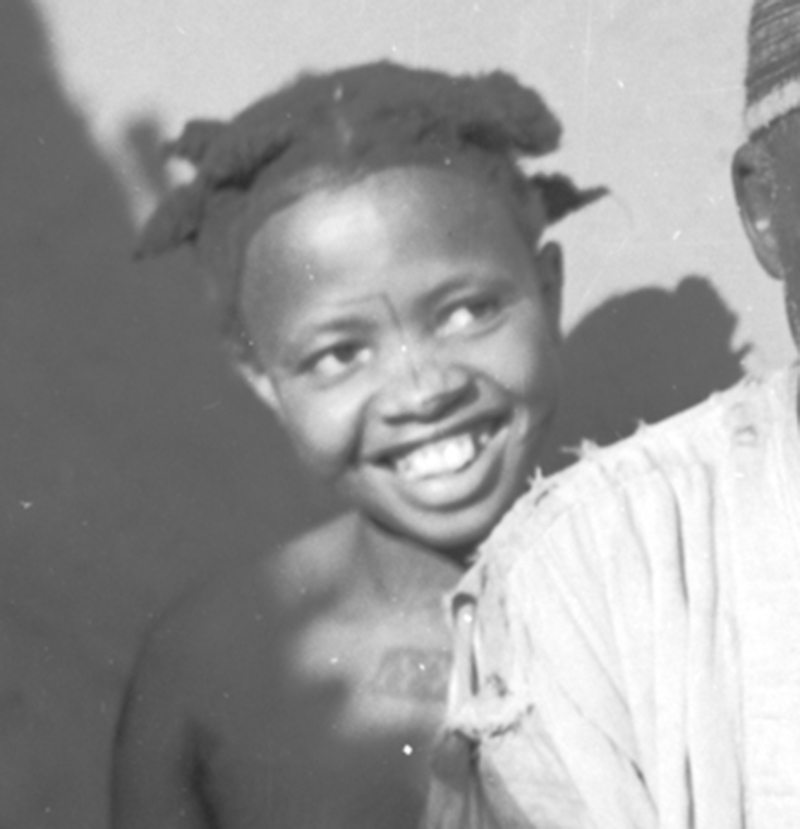
People who may be from Isuochi (as the album was labelled). Photographed by G. I. Jones, 1930s.

The ùrì body art of women who may be from Isuochi (as the album was labelled) [cropped].

Isuochi man

A man who may possibly be from Isuochi (as the album was labelled). Photographed by G. I. Jones, 1930s.

Ifogu Nkporo

"Ogu wooden face mask," part of the Nkporo people's Ifogu masquerade at Elugu Nkporo in p.d. Abia State, photographed by G. I. Jones in the 1930s.

Nkporo initiates

Young male Nkporo initiates dancing masks with tall fibre extensions, eastern Igbo area (p.d. Abia State), 1930s. Photo: G.I. Jones.

Igbo male hairstyles

Igbo male hairstyles from the northern area and one (bottom left) from Igbuzo. The photos were taken by Northcote Thomas in 1910-11, and G. T. Basden before 1921.

Thursday, December 20, 2018

Okpu Agha

An Igbo elder of Öka (Awka) wearing an okpu agha, or "war hat" as noted here by Northcote Thomas, 1910-11. Northcote Thomas' album, MAA Cambridge.

As a defence against ... weapons the Ibo had devised fibre 'crash' helmets or okpu agha. Those ... are entirely plaited out of the coarse fibre in the stems of Colocasia antiquorum. Dalziel remarks: 'The Ibos use caps or helmets and a kind of armour woven from the fibre got from the petioles.'

– M. D. W. Jeffreys (1956). "Ibo Warfare." Man, Vol. 56 (June, 1956). p. 78.

Agulu Igbo man

North Thomas' notes on an Igbo man from Agulu: "Side fringe[?], man. 1910-11. " This style appears on a number of Igbo men and may have some significance.

Northcote Thomas' album, MAA Cambridge.