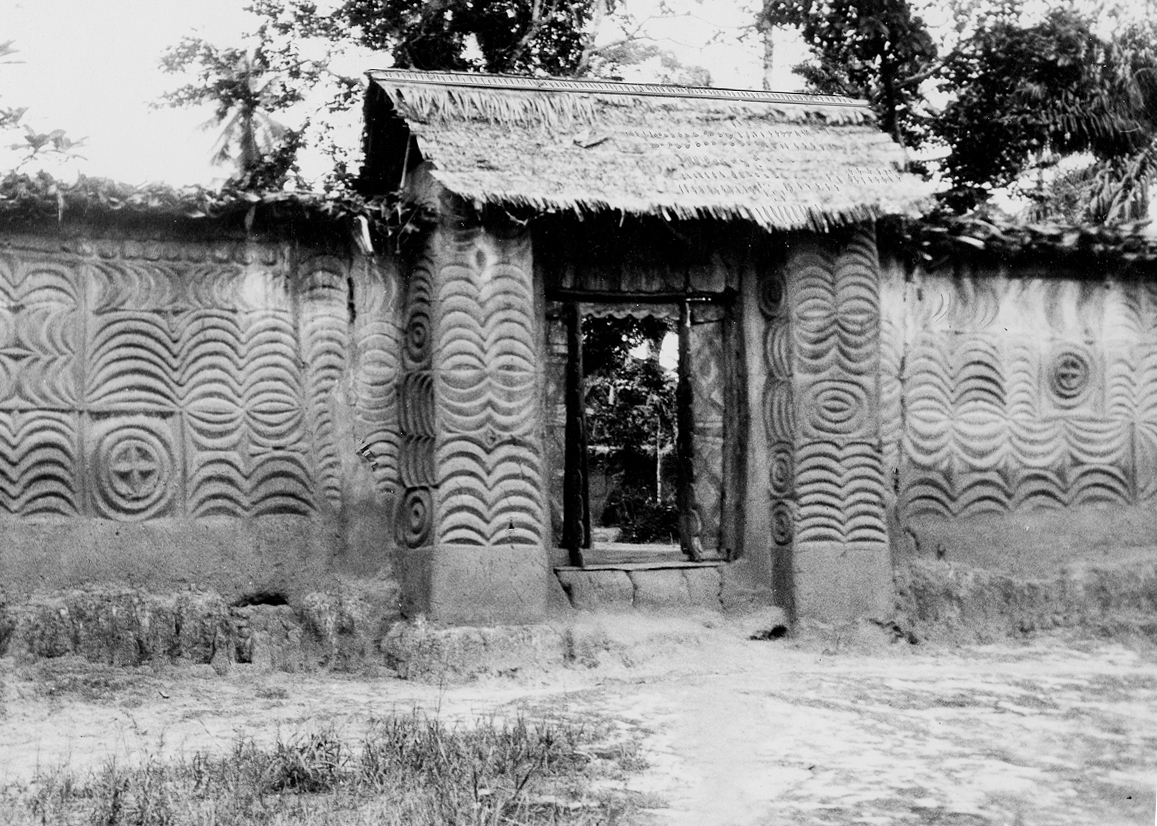
Entrance gate and walls with relief of a farmer's compound at Nnewi (noted as "Entrance to a compound of IGBO farmer's house near NEWI"), northern Igbo area, c. 1938. Photo: Edward Duckworth. Pitt Rivers Museum.
The pre-1940s history, indigenous culture, and heritage of Ìgbò through images.
Entrance gate and walls with relief of a farmer's compound at Nnewi (noted as "Entrance to a compound of IGBO farmer's house near NEWI"), northern Igbo area, c. 1938. Photo: Edward Duckworth. Pitt Rivers Museum.
 "Water play Bonny For Oko Jumbo" – Jonathan Adagogo Green (Ibani photographer). 1895-1905. British Museum.
Bonny was a powerful coastal state and major port during the slave and palm oil trade. Bonny, Ibani, known as Ụ̀banị̀ in the Igbo interior, set on trading expeditions into the creeks with dozens of canoes holding up to 120 people each. During the slave trade, a group of Bonny slaving canoes could reportedly carry back up to 2000 people from the interior. The creeks were major highways for trade. The Ụ̀banị̀ people brought European cloth and other goods such as gin, pomade, and other European-made drinks to the traders in the interior.

"At the Akquete [Akwete] Market" by Jonathan Adagogo Green, an Ibani (Bonny) photographer, 1895-1905. British Museum. The Ndoki (which Akwete is a part), Asa, and Omuma area is collectively referred to as Ụ̀kwà, which apparently means wealth.
Before the 20th century, this area was a major market area including the Ohambele, Ohanku, Azumini, and Akwete markets that served as meeting points for Igbo groups and coastal middlemen, especially the Ubani or Ibani (of Bonny Island) who brought up European goods to be traded.
 Symbol of Ala, the Earth Mother, among the Eda Igbo, present-day Abia or Ebonyi State. P. A. Talbot, c. 1920s.
Most Igbo people in the past did not perceive themselves as belonging to a religion. The split between culture and religion did not exist. All practices were viewed as duty. This view of duty, compulsory rites that place tradition and service and reverence to ancestors over belief itself, still exists in the kola nut rite, ịche ọjị, for example, which could've been classed as a religious rite.
 This is likely Nwa Agụ, in Umuahia, the leopard Ọ̀kọ̀nkọ̀ mask worn by high ranking men as the emblem of the society. The costume's chequers represent leopard spots. The masker is signing (nsibidi?). Photo: G. I. Jones, c. 1930s. MAA Cambridge.
Uwaga Okeanya, aged c.90 (an Ọ̀kọ̀nkọ̀ priest), in Ogbodiuumwu [Ogbodiukwu?], Ụmụọpara, 12 August 1972

John Brown (c.1810 – 1876) was born into slavery in Virginia. He said in his life story that his father's father was an Igbo (written Eboe) man stolen from Africa. John Brown’s family was split several times by the time he was ten. He was later sold to people who tortured him for medical experiments, as was often done on many people of African descent. John Brown managed to escape and gain freedom and dictated his life story, published in 1855 as “Slave Life in Georgia: A Narrative of the Life, Sufferings, and Escape of John Brown, A Fugitive Slave, Now in England.”
August 2019 is 400 years since the beginning of the enslavement of Africans in the British Colony of Virginia which later became a US state. Virginia is also noted to have received a large amount of Igbo people during the 18th century.

Agbọ mmụọ, Igbo maiden spirit masks, early 20th century. These masks are worn by men and the design of the costumes incorporate the cosmetics, ornaments, and dress of women in the community. Their outing brings a balance of femininity to masquerade festivals. They play a role in the veneration of the Earth Mother through their appearance at festivals.

This is the kind of hairstyle worn by young Igbo men around the northern side of the Igbo area. The photo was taken around the 1920s. Young guys grew their hair like this for the same reasons young guys grow their hair today.
 Photo: An Öka (Awka) elder and another man during a war demonstration. Photographed by Northcote Thomas, c. 1910-11. MAA Cambridge.
Large body shields are commonly ọta, dialect depending; smaller lighter wicker shields èkpèkè. Shield: ọta; wicker/straw shield: èkpèkè, egbeje; gun shield: òkoro.
The Ibo warrior also carried shields which were of two types. One was a heavy wooden shield. This was used for home defence when defending a town against attack. It was too heavy to be carried on raids or forays and was then replaced by a light wicker shield made from laths cut from the midrib of the oil palm (Elæis guineënsis) or of the Borassus palm (Borassus æthiopica). These wicker shields are found widely distributed.
– M. D. W. Jeffreys (1956). "Ibo Warfare."

Ọ̀gbọ agha. A war demonstration by men whose names do not appear to have been noted, photographed by Northcote Thomas, c. 1910-11. The men have swords/machetes, shields made from either wood or the 'midrib of oil palms', and war hats. The location is given as Awka. Colourised Ụ́kpụ́rụ́ 2019. MAA Cambridge.
 Original.
Duties of the (Igbo) second burial (ịkwa ozu?) according to the European source, early 20th century. This is probably for a very prominent person. The photograph is also likely from today's Anambra State.


Photo: The Otiri masquerade of Ebiriba (Abiriba), a masquerade, of the Iri Ama festival, that praises beautiful women of the community for gifts. Photographed in the 1930s by G. I. Jones. MAA Cambridge.
Ebiriba (Abiriba) was one of the centres of blacksmithing in the Igbo area. The smiths from Ebiriba were itinerant and had bases outside of their homes in nearby towns like Uzuakoli. The smithing trade was so central to the economy of Ebiriba that ụzụ (smithing) in Ebiriba refers to any sort of long-distance trade.
The settlement of Ebiriba appears to coincide with the general eastward expansion of the Igbo people in the Cross River area. Included in this migration were the Ohafia, Aro, Abam, and Eda and Nkporo people. Like in most parts of the Igbo area, the migrations are very mixed and complex, some moving back on one another. In legend, the Aro, Abam, Ohafia, Eda, and Ebiriba people are said to have links to a progenitor, Eze, who came from Ibeku in today's Umuahia.
The links between Ohafia and Ibeku are well established through a legend recounting Ohafia's departure from Isieke, a village in Ibeku, as well as the rights Ibeku people have in Ohafia as members of the elder settlement and as kin. Customs linking the Ebiriba and other Cross River groups and Ibeku are not as strong. It is, however, likely that these Cross River Igbo groups did migrate from the Ibeku and the general Umuahia area.
The Ebiriba and Aro are linked in tradition as coming from the same migration. All these Cross River Igbo groups backed the Aro militarily during their ascension in the late 17th century; this bond is now popularly known as the Aro Confederacy. The Cross River Igbo groups all have strong connections with non-Igbo Cross River groups.
See: Philip Nsugbe (1974). "Ohaffia: A Matrilineal Ibo People"; John Oriji (1994). "Traditions of Igbo origin".
