Original

Igbo names and spellings for various settlements
Abakaliki is Abankaleke; Afikpo is Ehugbo; Awgu is Ogu; Awka is Oka; Bonny is Ubani; Enugu is Enugwu; Ibusa is Igbuzö; Igrita is Igwuruta; Oguta is Ugwuta; Onitsha is Onicha; Owerri is Owere; Oyigbo is Obigbo... any more will be added.

Sunday, January 26, 2020

The White Man on a Bike

“A stop & gossip on the road from Owerrinta to Owerri.” c. 1919-1932. MAA Cambridge.

The story of a white man dragged off a bicycle and killed while riding in the Igbo country has been told in different ways, even in Chinua Achebe's "Things Fall Apart". The man, a doctor named Stewart, was actually killed due to mistaken identity during resistance to the British.

The incident happened in November 1905, in Mbaise, while Dr. Stewart was attempting to catch up with a convoy of colonial troops from Owere to Calabar by bicycle. He was captured and paraded through several areas and finally killed in the Afo market of Onicha Amairi, his body never found.

Sunday, January 5, 2020

The Igbo Tradition of Oratory

Photo: Postcard via the Library of Congress.

There's been focus on the importance of the individual's voice in Igbo societies. The following short examples examine traditions of consensus decision-making and how they have influenced behaviour, relationships, and communication.

Consensus decision-making in Igbo society lead to the development of a particular persuasive way of speaking. Misty L. Bastian on debates between missionaries and members of Önïcha society.

Sunday, December 29, 2019

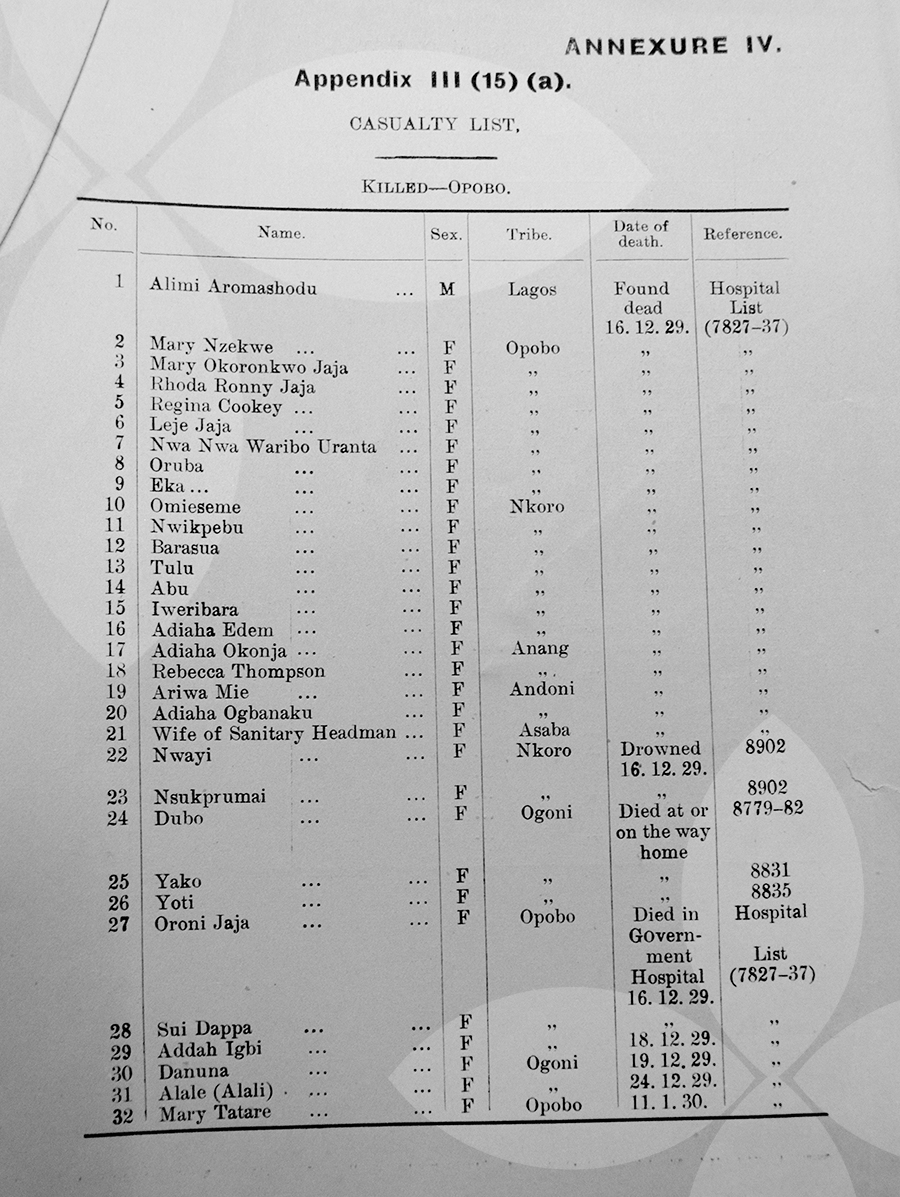
Women's War British casualty list

Official British record of people, primarily women, killed or injured during the Women's War of the Calabar and Owerri colonial provinces, 1929-30.

Saturday, December 28, 2019

Öka man's hair

"Achetefu(?) young man." … "Hairdressing (Ibo) Man of Awka". Northcote Thomas, c. 1911. MAA Cambridge.

Monday, December 23, 2019

Ogboli Origins: A Western Igbo Ǹrì (Ǹshì) People

"Water Side Assaba." The Oshimili (Niger River) at Asaba c. 1889. Pitt Rivers Museum.
At Ani Udo, Edini […] prospered. […] Oral historians believe that many of the Ogboli clans that dot Anioma today were formerly the inhabitants of the original Ogboli community that was founded by Edini in Ani Udo. They also believe that the Benin-Anioma wars played a major role in dispersing the original residents of the Ogboli community, forcing them to abandon their homes at Ani Udo. Some moved closer to Igbuzo, where their new settlement became known as Ogboli-Igbuzo. Some moved to Issele-Ukwu to occupy the Ogboli-Issele-Ukwu quarters. Many more moved to Atuma and Akwukwu, while a large party fled across the Niger river to settle in Ogboli-Onitsha.

– Don C. Ohadike (1994). “Anioma: A Social History of the Western Igbo People”. p. 17.

Wednesday, December 18, 2019

Ila Elder, Origins

An elder in Ila (Illah) holding an abani or eben sword, present-day Delta State. Photographed by Northcote Thomas, c. 1912. MAA Cambridge.

Illah is said to have been founded by Ala[.] […] One of the traditions holds that Ala’s father, lka, came from Nteje (some informants say he came from Nri) and the mother, Ejini, came from lgalaland. […] While at Omorka, the Anam/Nzam people from the east of the Niger frequently harassed the Illah. Through the assistance of a later immigrant, an Edaiken (Oba's first son) from Benin, the Illah contained the Anam's menace. […] The Asaba and Illah traditions seem to indicate a fusion of Igbo and Igala migrants, and emphasize the age-long relationship between them and the Igala in the north and the Igbo in the east.

– Adiele Afigbo (1992). "Groundwork of Igbo history." p. 335.

Monday, December 16, 2019

The road from Ụgwụtā to Òwèrè, c. 1909

The road from Ụgwụtā (Oguta) to Owere (Owerri), c. 1909, showcasing the undulating landscape of the Igbo country.

Whether this is a ‘pre-colonial’ road or not is not specified, but this could be how trade routes were in the past.

Nigeria, 1932 [cropped]. Library of Congress.

The Igbo area is one of the most densely populated areas in the world. Relative stability over centuries made it so. Developmentally, it may turn into one metropolitan area, with considerations for nature and the environment.

Sunday, December 15, 2019

Women's War: 1930 British Report Map

A map from an official 1930 British colonial government report on the Women's War of the Calabar and Owerri Provinces (1929-1930). The pink dots (enhanced) pinpoint places where "firing took place," the blue dots are Native Courts that were either damaged, burnt, or destroyed.

Saturday, December 14, 2019

Government School, Owerri District, c. 1909

Government School, Owerri District, c. 1909.

Colonial Home, Enugwu

Home of a member of the British colonial establishment, Enugu. Staged photo, 1930s(?). The people standing are named, from left: Adebayo, Kanu(?), unnamed person(?), Thomas, two "gardeners," an unnamed person, and a "cook" on the right.

In all contact with the natives, let your first thought be the preservation of your own dignity. The natives are accustomed to dealing with very few white people and those they meet hold positions of authority. The British are looked up to, put on a very high level. Don't bring that level down by undue familiarity.

– WWII instructions given to white troops stationed in West Africa. From the West African Review, January 1943.

Tuesday, December 10, 2019

Edward Wilmot Blyden

Edward Wilmot Blyden, pictured c. 1851-1860, daguerreotype of a young Edward Wilmot Blyden by Rufus Anson. Library of Congress.

Edward Wilmot Blyden (August 3, 1832 – February 7, 1912) was a West Indian-born writer and politician who described both his parents as being of complete Igbo ancestry.

As the father of pan-Africanism, he was an educator, writer, diplomat, and politician after settling in Liberia and afterwards Sierra Leone. Born in the Virgin Islands in the West Indies, he joined the free black immigrants from the United States who migrated to the region. He taught for five years in the British West African colony of Sierra Leone in the early 20th century. His writings on pan-Africanism were influential in both colonies.

Sunday, December 8, 2019

"Are you a Mason?"

Are You a Mason? A Member of the Egbo, A Nigerian Secret Society, In Costume.
The most important and widespread of the secret societies in Nigeria is the Egbo society, which…may almost be compared to Freemasonry in England. The dress worn by the lowest-grade members is something like a diver’s suit. The man has fringes of black and red grass round his ankles, and, covering his face, is a mask of wood painted white. (p. 774)

– 1909. “At the Sign of St. Pauls.” The Illustrated London News, Vol. 134, No. 3658. Ross Archive of African Images (RAAI).