Original

Igbo names and spellings for various settlements
Abakaliki is Abankaleke; Afikpo is Ehugbo; Awgu is Ogu; Awka is Oka; Bonny is Ubani; Enugu is Enugwu; Ibusa is Igbuzö; Igrita is Igwuruta; Oguta is Ugwuta; Onitsha is Onicha; Owerri is Owere; Oyigbo is Obigbo... any more will be added.
Showing posts with label Men. Show all posts

Monday, July 6, 2020

People

Two women who are most likely Igbo and from the Önïcha area judging by the presence of the Obi Önïcha in related photos. Photographed by Herbert Wimberley, c. 1903-18. Cambridge University Library.

The pair posing with a man with a staff in the middle that looks to be a staff for men who hold the ǹzè title (alọ̀).

Saturday, May 16, 2020

Ọ̀kọ̀nkọ̀ Tolls

An Ekpe masquerader in Uzuakoli, present-day Abia State. Photographed by G. I. Jones, 1930s. MAA Cambridge.

Ọ̀kọ̀nkọ̀ members controlled important roads in the eastern Igbo area. British imperial interests ran against this system.

Passing by Abruki, which had, however, to be " dashed " in the usual way, we arrived in the evening at Omo-pra [Ụmụ̀ọpara?], the last mile or two into the town being more like an avenue in England, shaded by splendid trees, than a wild roadway in Africa. […] Under a lowering sky, and in a, slight drizzle of rain, we left Omo-pra early the next morning[.]

"A Famous Were-Leopard"

"A Famous Were-Leopard". Percy Amaury Talbot. Internet Archive.
The power of metamorphosis is generally termed Uworraw-Ukponn, corresponding to the Ibo word Ehihi, and is sometimes inherited, sometimes bought. Since many believe that it is only used for evil purposes, the faculty is not often boasted of, or admitted, by its possessor. Nearly all " strong " animals in the bush, such as leopards, elephants, etc., are credited with being were-beasts, but such can only be recognised by hunters, who, unless bad men, would not shoot them, since their death would entail that of their affinity.

Tuesday, May 12, 2020

Prince Chukwuma of Àbọ, William Baikie

"Prince Tshúkuma [Chukwuma]" of Abö, illustration from an 1854 voyage by William Baikie. Internet Archive.
[At Abö] we learnt that King Obí [Osai] had been dead for nearly nine years, and that since that time there had been no regular king. At Abó, the chief power is elective, and after the death of Obí two parties sprung up, one of which supported the claims of his son, while the other advanced as their candidate an influential person named Orísa. The two sections were respectively entitled the king's people and the Oshiodápara party. Obí's friends were unanimous in their selection of Obí's second son, named Ajé, an active, intelligent, young man ; and this was acquiesced in by his less energetic and more peaceful brother Okúrobi or Tshúkuma.

Wednesday, May 6, 2020

'The King of the Eboes'

People on the island of Jamaica. USC Digital Library.

March 22, 1816. A European's account of a thwarted African uprising in Jamaica.

The two ringleaders of the proposed rebellion at St. Elizabeth's have been condemned, the one to be hanged, the other to be transported. The plot was discovered by the overseer of Lyndhurst Penn (a Frenchman from St. Domingo) observing an uncommon concourse of stranger negroes at a child's funeral, on which occasion a hog was roasted by the father. […] They had elected a King of the Eboes [Igbo], who had two Captains under him;

Friday, April 17, 2020

Palm Oil

A palm oil factory photographed by Jonathan Adagogo Green likely in either Opobo or Bonny, c. late 19th century. British Museum.

The palm oil industry grew after the sixteenth century as a provisional source for the growing international and slave trade. After the palm oil industry replaced the slave trade from roughly around the 1840s, the southern Igbo area became the biggest producer of palm oil in the world by the 19th century, accounting for over one-third of West African palm oil exports by the colonial era. Palm oil also dominated the economies of other areas of the Niger Delta, such as the Urhobo and Isoko areas.

Saturday, March 14, 2020

Shrine to Agwụ̀

Titled elder Onyeso of Agukwu Nri washing hands for a rite before a shrine to Agwụ̀, a divinity of doctors (dibị̀à). Photographed by Northcote Thomas in 1911. MAA Cambridge.

Agwụ̀ is an entity of unconventionality and hence creativity that guides the dibị̀à. Agwụ̀ is related to strange occurrences and mishaps. Such occurrences are often signs to individuals that are destined to become doctors.

Friday, February 14, 2020

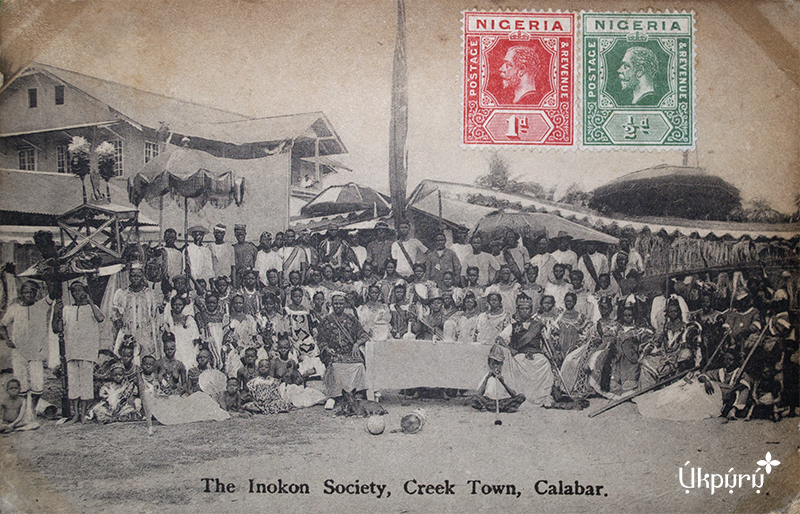
"Inokon"

"The Inokon Society, Creek Town, Calabar." Postcard from c. 1910s-20s. Ụ́kpụ́rụ́ Collection.

Inokon or Inokun may be related to Okon, a founding figure in the history of Arochukwu. It is the name the Aro people are known by in the Cross River area.

The Aros are often called Inokuns. Authorities disagree as to the difference between these names. It is stated that the Aros are the aristocratic or freeborn caste of the Inokun tribe, that there are sixteen Aro towns, each presided over by a chief of its own, and that these chiefs in united council used to govern the whole Inokun tribe. Of these sixteen towns, all in the near neighbourhood of the "Long Juju," the principal is Ibum [Ibom]. The Assistant District Commissioner used to live down in the town itself, but it was found to be damp and unhealthy, so the station was moved to the top of a hill about one and a half miles outside, previously occupied as an outlying farm of the township. Ibum is marked "Aro Chuku'' on the map, and the Government residence stands about midway between Aro Chuku and Obagu. From this hill one looks down upon the Aro towns, indicated in the densely wooded valley by the columns of blue smoke overhanging them.

Saturday, December 28, 2019

Öka man's hair

"Achetefu(?) young man." … "Hairdressing (Ibo) Man of Awka". Northcote Thomas, c. 1911. MAA Cambridge.

Wednesday, December 18, 2019

Ila Elder, Origins

An elder in Ila (Illah) holding an abani or eben sword, present-day Delta State. Photographed by Northcote Thomas, c. 1912. MAA Cambridge.

Illah is said to have been founded by Ala[.] […] One of the traditions holds that Ala’s father, lka, came from Nteje (some informants say he came from Nri) and the mother, Ejini, came from lgalaland. […] While at Omorka, the Anam/Nzam people from the east of the Niger frequently harassed the Illah. Through the assistance of a later immigrant, an Edaiken (Oba's first son) from Benin, the Illah contained the Anam's menace. […] The Asaba and Illah traditions seem to indicate a fusion of Igbo and Igala migrants, and emphasize the age-long relationship between them and the Igala in the north and the Igbo in the east.

– Adiele Afigbo (1992). "Groundwork of Igbo history." p. 335.

Saturday, December 14, 2019

Colonial Home, Enugwu

Home of a member of the British colonial establishment, Enugu. Staged photo, 1930s(?). The people standing are named, from left: Adebayo, Kanu(?), unnamed person(?), Thomas, two "gardeners," an unnamed person, and a "cook" on the right.

In all contact with the natives, let your first thought be the preservation of your own dignity. The natives are accustomed to dealing with very few white people and those they meet hold positions of authority. The British are looked up to, put on a very high level. Don't bring that level down by undue familiarity.

– WWII instructions given to white troops stationed in West Africa. From the West African Review, January 1943.

Tuesday, December 10, 2019

Edward Wilmot Blyden

Edward Wilmot Blyden, pictured c. 1851-1860, daguerreotype of a young Edward Wilmot Blyden by Rufus Anson. Library of Congress.

Edward Wilmot Blyden (August 3, 1832 – February 7, 1912) was a West Indian-born writer and politician who described both his parents as being of complete Igbo ancestry.

As the father of pan-Africanism, he was an educator, writer, diplomat, and politician after settling in Liberia and afterwards Sierra Leone. Born in the Virgin Islands in the West Indies, he joined the free black immigrants from the United States who migrated to the region. He taught for five years in the British West African colony of Sierra Leone in the early 20th century. His writings on pan-Africanism were influential in both colonies.

Friday, December 6, 2019

Onye Ọcha

Onye Ọcha mask, Igbo parody of a white man during the colonial era from Amobia, part of a larger play. Apart from more serious ritual masks, a key part of many Igbo masquerading festivals are comedic and satirical masks. G. I. Jones, 1930s. MAA Cambridge. [Consider the photographer.]

Ghost policemen masks, symbols of colonial powers, part of the same masquerade play as the Oyibo or Onye Ọcha mask from Amobia. G. I. Jones, 1930s. MAA Cambridge.

Sunday, December 1, 2019

The Western-style school established in 1870s Opobo

Photo: King Jaja of Opobo, The New York Public Library.

The Western-style school established in 1870s Opobo by King Jaja and other Africans before British colonisation.

The aspect of modernization that deeply interested Jaja was the acquisition of secular education, which he considered essential if his people were to profit from their commercial enterprise. Because he could barely read and write he had to employ a private secretary, a Sierra Leonean known as D. C. Williams, who became responsible for maintaining his correspondence with the British. In 1873 Jaja sponsored the opening of a school at Opobo with another Sierra Leonean, Mr. Gooding, as the teacher. Twelve years later the population of this school stood at sixty boys and girls, under the instruction of an American Black woman, Emma Johnson. According to one visitor, the standard of education attained by the children was comparable to that of English children of the same age.

– Sylvanus John Sodienye Cookey (1974). “King Jaja of the Niger Delta: His Life and Times, 1821-1891.”

Wednesday, November 13, 2019

A View of the Arọ̀ from Igbere

Before the Europeans came, the Arọs […] main interest in their trade was the purchase of slaves. […] Some of them came as medicine men, […] traders […] agents of Ibìna Ụ̀kpaàbị̀. We called them Ọbụ̄ Arọ̀ bụrụ Ìgbò (He is Arọ as well as Igbo), […] Arọ̀ Oke-Ìgbò, […] Inokun. […]

Monday, November 11, 2019

Ndị Ìgbò

An unidentified group portrait taken by a Royal Niger Company employee c. 1886 - 1895. Based on other photos, these could be people from the Asaba or Önïcha area. MAA Cambridge.

Wednesday, November 6, 2019

Ezeani Obidigbo of Neni

"Chief Obudugbo. Ezeana of Neni" [Ezeani Obidigbo of Ugwudunu, Neni?]. Photographed by Northcote Thomas, c. 1910-11. MAA Cambridge.

The keepers of Ani (Ala), the shrine of the Earth Mother, are usually the autochthonous section of a community, a group that can trace their patriline to the original settlers of a community. Ndị nwe Ànà are the highly respected and revered spiritual leaders of a community due to the supremacy of Ani in Igbo society. To keep the Ani is to keep the laws of the land.

Various communities have their own personal Ani because of their unique relationships with Ani and the work in setting up the shrine.

Sunday, October 27, 2019

Ụ̀banị̀

"Water play Bonny For Oko Jumbo" – Jonathan Adagogo Green (Ibani photographer). 1895-1905. British Museum.

Bonny was a powerful coastal state and major port during the slave and palm oil trade. Bonny, Ibani, known as Ụ̀banị̀ in the Igbo interior, set on trading expeditions into the creeks with dozens of canoes holding up to 120 people each. During the slave trade, a group of Bonny slaving canoes could reportedly carry back up to 2000 people from the interior. The creeks were major highways for trade. The Ụ̀banị̀ people brought European cloth and other goods such as gin, pomade, and other European-made drinks to the traders in the interior.

Friday, October 25, 2019

Ụ̀kwà

"At the Akquete [Akwete] Market" by Jonathan Adagogo Green, an Ibani (Bonny) photographer, 1895-1905. British Museum. The Ndoki (which Akwete is a part), Asa, and Omuma area is collectively referred to as Ụ̀kwà, which apparently means wealth.

Before the 20th century, this area was a major market area including the Ohambele, Ohanku, Azumini, and Akwete markets that served as meeting points for Igbo groups and coastal middlemen, especially the Ubani or Ibani (of Bonny Island) who brought up European goods to be traded.

Tuesday, October 1, 2019

Interview of an Ọ̀kọ̀nkọ̀ priest born in c. 1880s Umuopara

This is likely Nwa Agụ, in Umuahia, the leopard Ọ̀kọ̀nkọ̀ mask worn by high ranking men as the emblem of the society. The costume's chequers represent leopard spots. The masker is signing (nsibidi?). Photo: G. I. Jones, c. 1930s. MAA Cambridge.
Uwaga Okeanya, aged c.90 (an Ọ̀kọ̀nkọ̀ priest), in Ogbodiuumwu [Ogbodiukwu?], Ụmụọpara, 12 August 1972