Original

Igbo names and spellings for various settlements
Abakaliki is Abankaleke; Afikpo is Ehugbo; Awgu is Ogu; Awka is Oka; Bonny is Ubani; Enugu is Enugwu; Ibusa is Igbuzö; Igrita is Igwuruta; Oguta is Ugwuta; Onitsha is Onicha; Owerri is Owere; Oyigbo is Obigbo... any more will be added.
Showing posts with label Europeans. Show all posts

Sunday, May 17, 2020

Bridge over Imo River

Bridge over Imo River. Published 1920. Internet Archive.

A temporary wooden bridge over the Imo River for the Eastern Division railway line built from 1913 to access the Udi coalfields around Enugwu Ngwo, terminating at the Diobu cliffs of the new port named Port Harcourt by Frederick Lugard. It was originally intended for the line to extend further north to Kaduna to join the Western Division railway to Kano, but the outbreak of WWI led to postponement. The work on the 151 mile section from the port to the Udi hills was prioritised due to the wartime need for coal.

Saturday, May 16, 2020

Ọ̀kọ̀nkọ̀ Tolls

An Ekpe masquerader in Uzuakoli, present-day Abia State. Photographed by G. I. Jones, 1930s. MAA Cambridge.

Ọ̀kọ̀nkọ̀ members controlled important roads in the eastern Igbo area. British imperial interests ran against this system.

Passing by Abruki, which had, however, to be " dashed " in the usual way, we arrived in the evening at Omo-pra [Ụmụ̀ọpara?], the last mile or two into the town being more like an avenue in England, shaded by splendid trees, than a wild roadway in Africa. […] Under a lowering sky, and in a, slight drizzle of rain, we left Omo-pra early the next morning[.]

"A Famous Were-Leopard"

"A Famous Were-Leopard". Percy Amaury Talbot. Internet Archive.
The power of metamorphosis is generally termed Uworraw-Ukponn, corresponding to the Ibo word Ehihi, and is sometimes inherited, sometimes bought. Since many believe that it is only used for evil purposes, the faculty is not often boasted of, or admitted, by its possessor. Nearly all " strong " animals in the bush, such as leopards, elephants, etc., are credited with being were-beasts, but such can only be recognised by hunters, who, unless bad men, would not shoot them, since their death would entail that of their affinity.

Tuesday, May 12, 2020

Prince Chukwuma of Àbọ, William Baikie

"Prince Tshúkuma [Chukwuma]" of Abö, illustration from an 1854 voyage by William Baikie. Internet Archive.
[At Abö] we learnt that King Obí [Osai] had been dead for nearly nine years, and that since that time there had been no regular king. At Abó, the chief power is elective, and after the death of Obí two parties sprung up, one of which supported the claims of his son, while the other advanced as their candidate an influential person named Orísa. The two sections were respectively entitled the king's people and the Oshiodápara party. Obí's friends were unanimous in their selection of Obí's second son, named Ajé, an active, intelligent, young man ; and this was acquiesced in by his less energetic and more peaceful brother Okúrobi or Tshúkuma.

Friday, April 17, 2020

Palm Oil

A palm oil factory photographed by Jonathan Adagogo Green likely in either Opobo or Bonny, c. late 19th century. British Museum.

The palm oil industry grew after the sixteenth century as a provisional source for the growing international and slave trade. After the palm oil industry replaced the slave trade from roughly around the 1840s, the southern Igbo area became the biggest producer of palm oil in the world by the 19th century, accounting for over one-third of West African palm oil exports by the colonial era. Palm oil also dominated the economies of other areas of the Niger Delta, such as the Urhobo and Isoko areas.

Tuesday, February 4, 2020

Igbo Compound Tower

"An [Igbo] chief’s compound, with war-tower and inner wall; natives listening to phonograph; Azia, Onitsha district." A. E. Kitson, published 1913.

Each house stood in a compound surrounded by a high mud wall. There were small loop holes in the walls at equal distances, through which a gun could be fired in the event of an enemy attacking the town. In each compound also there was generally at least one high tree with a platform in its branches, from which a good lookout could be obtained. We noticed also two large, square watch-towers, three times the height of ordinary houses.

– T. J. Dennis (1899). Itineration in the Ibo Country. p. 780.

Sunday, December 15, 2019

Women's War: 1930 British Report Map

A map from an official 1930 British colonial government report on the Women's War of the Calabar and Owerri Provinces (1929-1930). The pink dots (enhanced) pinpoint places where "firing took place," the blue dots are Native Courts that were either damaged, burnt, or destroyed.

Saturday, December 14, 2019

Colonial Home, Enugwu

Home of a member of the British colonial establishment, Enugu. Staged photo, 1930s(?). The people standing are named, from left: Adebayo, Kanu(?), unnamed person(?), Thomas, two "gardeners," an unnamed person, and a "cook" on the right.

In all contact with the natives, let your first thought be the preservation of your own dignity. The natives are accustomed to dealing with very few white people and those they meet hold positions of authority. The British are looked up to, put on a very high level. Don't bring that level down by undue familiarity.

– WWII instructions given to white troops stationed in West Africa. From the West African Review, January 1943.

Friday, December 6, 2019

Onye Ọcha

Onye Ọcha mask, Igbo parody of a white man during the colonial era from Amobia, part of a larger play. Apart from more serious ritual masks, a key part of many Igbo masquerading festivals are comedic and satirical masks. G. I. Jones, 1930s. MAA Cambridge. [Consider the photographer.]

Ghost policemen masks, symbols of colonial powers, part of the same masquerade play as the Oyibo or Onye Ọcha mask from Amobia. G. I. Jones, 1930s. MAA Cambridge.

Friday, October 25, 2019

Ụ̀kwà

"At the Akquete [Akwete] Market" by Jonathan Adagogo Green, an Ibani (Bonny) photographer, 1895-1905. British Museum. The Ndoki (which Akwete is a part), Asa, and Omuma area is collectively referred to as Ụ̀kwà, which apparently means wealth.

Before the 20th century, this area was a major market area including the Ohambele, Ohanku, Azumini, and Akwete markets that served as meeting points for Igbo groups and coastal middlemen, especially the Ubani or Ibani (of Bonny Island) who brought up European goods to be traded.

Tuesday, June 25, 2019

18th c. Ụ̀banị̀ Ìgbò vocabulary

Ụ̀banị̀ Ìgbò, the Igbo spoken on Bonny Island in today's Rivers State, recorded by the slave trader Captain Hugh Crow from the late 18th century, from "Memoirs of the late Captain Hugh Crow of Liverpool."

Bèkê seems to have been recorded here which brings the theory that it originated from the Scottish explorer William Baikie into doubt. Westermann, Smith, Forde (1932). Oxford University Press.

Bonny Island was one of the largest slave ports of the Atlantic slave trade era, especially in the late 18th century. Hugh Crow describes the predominance of Igbo captives on the island, most going to British colonies. "Memoirs..." p. 198.

This led to a large amount of Igbo people in the British Caribbean in particular, in places like Jamaica where this early 19th century description was made. John Stewart (1808). "An Account of Jamaica, and Its Inhabitants." p. 235–236.

Could some of these words have been recorded from some of the ancestors of people now in North America?

Saturday, May 11, 2019

Jịọjị

Photo: Sinhalese people and an Ikwere Igbo boy photographed during a Rumuji Owu play by G. I. Jones, c. 1930s, MAA Cambridge.

Have you heard of the lungi? This plaid material commonly known as madras is a textile from India that has become ethnic wear in southeastern Nigeria, known as George (Jịọjị) by the Igbo and injiri by the Kalabari. This is a brief history.

The lungi has been worn in India for centuries particularly in the south, today in India the lungi is relatively cheap and widely made and is associated with the working class. With British colonialism, the lungi was exposed to empire.

Madras, now Chennai, was a British East India Company post centred on the Fort St. George factory in the 17th century. It became the principal weaving and distribution spot for the lungi when empire exponentially increased its amount of weavers, marketing the madras worldwide.

Europe

The first description of the Igbo area written in Europe was made by the Portuguese explorer and sea captain Duarte Pacheco Pereira (c. 1460 – 1533) in the manuscript Esmeraldo de situ orbis, composed between 1505 and 1508, in which he describes "a land of negroes, called Opuu, where there is much pepper, ivory, and some slaves." 'Opuu' has been linked to 'Opu', the 19th century Igala term for the northern Igbo, other theories say 'Opuu' is the Jukun word for man, 'apu'.

Sunday, March 10, 2019

Thomas Thistlewood’s diary

An entry in Thomas Thistlewood’s diary, a British plantation overseer in Jamaica who eventually became a landowner and owner of enslaved people. Entry Aug. 12, 1776: A Jamaican (British) planters wife seeks “an Ebo girl, about 12 years of age” to be a “sempstress” “with small feet, not bow-legged, nor teeth filed, small hands & long, small taper fingers, &c.”

Image via Beinecke Digital Collections, Yale. Transcription via: Audra A. Diptee (2016). “A Great Many Boys and Girls.” In: Falola, T.; Njoku, R.C. eds. Igbo in the Atlantic World. p. 117.

Friday, March 8, 2019

"In Nigeria It Is The Women Who Propound Laws"

By CAROLINE ISAACSON

One of the most precious gifts a kindly providence can bestow upon one, W. L. George, a popular writer in the early days of the century, but alas little read today, once declared in one of his books, is a sense of adventure. That sense that sends one questing and which invests even a tram journey with- a certain amount of excitement. I thought of this when recently I met Mrs Kenneth Ross

For we got into conversation, and I learnt that she had been in Australia but a very short time, ana had spent the greater part of her life in Nigeria. Her coming to this country was via Singapore, the same as so many other newcomers to these shores.

The name Ross and Nigeria instantly recalled to my mind a book Ik had once read by Sylvia Leith

Ross about that particular part of the Empire, and I was most interested to learn that Mrs Leith Ross and my travelling companion were not only sisters-in-law, but had spent some considerable time together in Nigeria whilst the investigations which form the basis of the book were being made.

Mrs Kenneth Ross accompanied Mrs Leith Ross on many of her exploratory journeys. They travelled all over Nigeria, and the subsequent report on the life of the Ibos is considered one of the most comprehensive documentary research efforts compiled.

Life in Nigeria appears to be amusing as well as interesting. Marketing, for instance, Mrs Ross told me, she found not only a necessary but an exhilarating pastime. All the goods and foodstuffs are set out in the market in sections, and more by good luck than by good management lanes are somehow kept open between them. "It is true one had to pick out the needed pot from between 10 pairs of legs, and pull out the desired mat from under 20 garrulous women, and fowls were passed from hand to hand over the heads of the crowd until they reached the purchaser, and a sudden shriek would tell one a foot had inadvertently stepped into a cherished pot of pal oil; yet good temper reigned supreme, and even if a quarrel did arise it was quickly smothered by the laughter of the onlookers," was how she described a typical morn ing's shopping.

I was interested to learn that the Ibo women claim full equality with the men, and indeed Mrs Ross found them if anything the dominant partner. It is women's councils there who rule agricultural matters, and it is these which enact laws for the protection of crops, and enforce them by suitable penalties.

In so far as marriage is concerned, an Ibo girl becomes betrothed while still in infancy. The girl's dowry is paid on the instalment plan, and, what is more, the bridegroom has to pay a dowry to the bride's parents, and if he has not completed payments before 18 months after the first child arrives the parents can recall their daughter to their home, and the husband has no redress whatsoever!

Mrs Ross and I decided that although we Western women may pride ourselves on our enterprise and intelligence and perspicacity, there is still a great deal, it would seem—in comparison with the Ibos—we have to learn.
"In Nigeria It Is The Women Who Propound Laws— And Enforce Them" (1944, December 12). The Argus (Melbourne, Vic. : 1848 - 1957), p. 8. Retrieved March 8, 2019.

Monday, March 4, 2019

The Agbor Rising

Photo: "Mud figures of Chief and Attendants and Commissioner of Police. North Ika" – G. I. Jones, 1930s.
On 9 June 1906 the Ekumeku Society was in the news again, in connection with the killing of O.S. Crewe-Read [Iredi or Rédì], District Commissioner. Crewe-Read, together with an escort of fifty-three men, was on a visit to Uteh — a town in the Agbor district — and had halted for the day in Owa. [T]wo men, who were sent by Crewe-Read to summon the rest of the men of the town … returned late in the evening to report that the people refused to see him, … two policemen … sent to Agbor with telegrams … requesting assistance … were stopped … and the telegrams snatched from them. They barely escaped with their lives. With such a small force and no hope of immediate relief, Crewe-Read started back for Agbor on 9 June, but was ambushed at a place not far away from the town of Owa-Aliosimi. There he received two fatal gunshot wounds[.]
On receiving the news headquarters sent an army under Captain Rudkin to Agbor to ‘punish’ the killers, but in an encounter with the natives of Agbor, two European officers sustained serious wound, two soldiers were killed and twnety-six wounded. … A section of the column managed to reach Owa and did not encounter opposition immediately, and was therefore able to search for the body of Crewe-Read, which was found buried in the bush between the spot where he was killed and the town. It was exhumed and removed to Benin for burial. The battle that followed ended with the capture of the chiefs of Owa, Igbenoba, Inyibo, Ukute I, Ukute II, Ikaria, Ekuneme, Echenim, Tete and Ijioma. On 26 September 1906, these men were found guilty of murder and sentenced to execution by the judge of the supreme court of Nigeria, J.M.M. Dunlop.

– S. N. Nwabara (1978). “Iboland: a century of contact with Britain, 1860-1960”. p. 130–131.

———
[E]vents show the lack of sympathy coupled with the resort to driving tactics which could characterise early British rule in new districts. ... It was Crewe- Read's practice too, according to Gilpin, to flog the boys of the different towns in Agbor 'for not turning up to work on the roads as a rule'. Crewe-Read's … end in the Agbor district was … foreshadowed by the events of the first quarer of 1906. When he was an acting District Commissioner, Benin City district, the poeple of Alidinma had refused to see him at Akuku while on tour to the area. … Crewe-Read was not pleased by [the British D. C. Asaba’s] letter in which the … officer expressed the view that it was ‘hard not to say cruel to take people away at this time of the year'. Without any special qualification for knowing the Agbor people better, Crewe-Read pompously asserted that he ‘was the best judge if it was hard and cruel.

– Philip A. Igbafe (1967). "The 'Benin Scare' of 1906". In: “The African Historian”. pp. 10–11.

Sunday, March 3, 2019

The Twenty Years War

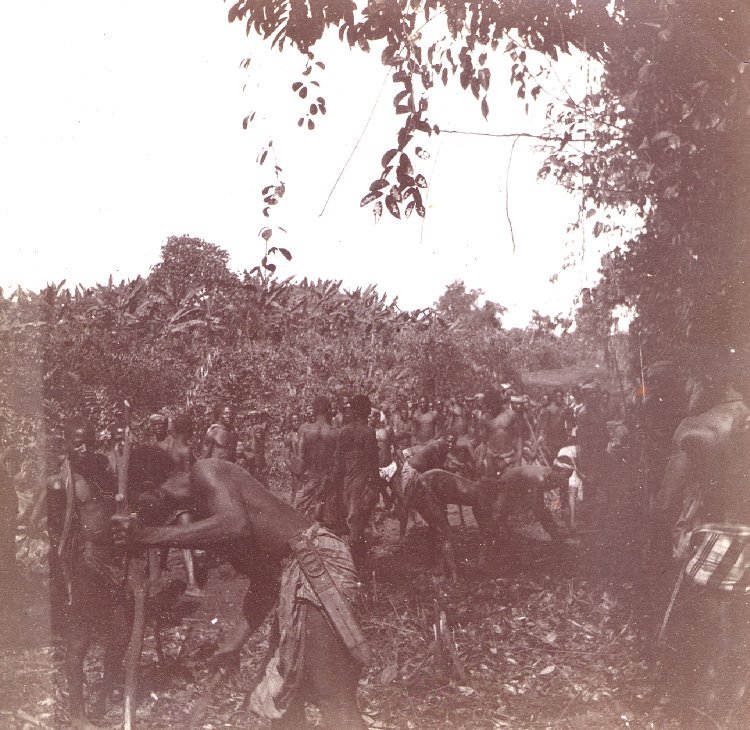
"Aro natives making road for us by order outside Bendi [Bende] Cutting bush with matchets" during the 'Aro Punitive Expedition', or Anglo-Aro war, 1901. British Museum.
Far from willingly conceding their territory to the military patrols, the people of Southeastern Nigeria opposed the British advance in more than three hundred pitched battles over a twenty year period, suffering at least ten thousand casualties. [...] Although violent resistance could not halt the British advance, it was effective in moderating and speed and thoroughness of that advance and in enabling Southeastern Nigerians to retain a measure of self-determination over the rate at which they absorbed technological and other changes.

– Robert D. Jackson (1975). "The Twenty Years War, Invasion and Resistance in Southeastern Nigeria 1900-1919".

Nsibidi Bende

208. On left breast of Essem, a Bende [Igbo] man (a man offered two rods to a woman, but she refused them and turned her back upon him).

– Elphinstone Dayrell (1911). "Further Notes on ‘Nsibidi Signs with Their Meanings from the Ikom District, Southern Nigeria." The Journal of the Royal Anthropological Institute of Great Britain and Ireland, vol. 41.

Onicha Titled Elder

"A chief of Onicha [Onitsha] wearing a schako [hat] of the Royal Guard of England in which he has fixed bird feathers." Via the French Foreign Legion officer, Antoine Mattei, late 19th century. Gallica Bibliothèque nationale de France.

Nsibidi Writing

Photo: Ikpe case from Enyong in nsibidi recorded by Macgregor (1909).
In a class I was teaching, a pupil deeply resented the statement that the civilisation of the people in Nigeria was primitive because they had no writing. He [Ezeikpe Agwu?] declared that they had a writing called nsibidi. This happened in April, 1905. ... I set myself to find out all I could about nsibidi. People smiled when I asked for information and declared that they knew nothing about it. The reason for this is that in Efik nsibidi is used almost only to express love [and sex], and this term covers such a multitude of most abominable sins that no self-respecting Efik person will confess that he knows anything, about the writing of it. ... Still from them it was possible to see that here we have a genuine product of the native civilisation the origin of which is so old as to have become the subject of a Märchen.

– J. K. Macgregor (1909). Notes on Nsibidi.