Original

Igbo names and spellings for various settlements
Abakaliki is Abankaleke; Afikpo is Ehugbo; Awgu is Ogu; Awka is Oka; Bonny is Ubani; Enugu is Enugwu; Ibusa is Igbuzö; Igrita is Igwuruta; Oguta is Ugwuta; Onitsha is Onicha; Owerri is Owere; Oyigbo is Obigbo... any more will be added.
Showing posts with label Diagrams. Show all posts

Saturday, April 20, 2019

Model of Igbo Cosmology

Some of the ideas are theoretical like the placement of the days. Some of the structure and ideas are partly via Obiakoizu A. Iloanusi (1984) and from the Kongo cosmogram.

The sun is an analogy, if that's the right word, for a person's life through the mortal (elu ụ̀wà) to the spirit (Àlà mmụọ), a person may be reincarnated with a unique Chi and the Ekè (characteristics) of their ancestor, and may pass through morning, afternoon, and evening.

When the person has a complete mortal cycle (reaching ụ̀wà mgbèdè, the evening of one's life), they enter the spirit realm awaiting burial, a second burial guiding them to ancestorhood, and then ancestorhood awaiting reincarnation.

The Chi and Ekè duality is repeated, or represented, in or by several other principals of the universe, the numbers 2, 4, 8, as alluded to in another post, are important numbers.

(The circle, the path, may be likened to, or represent the Igbo allusion to ụzọ̀.)

Friday, July 27, 2012

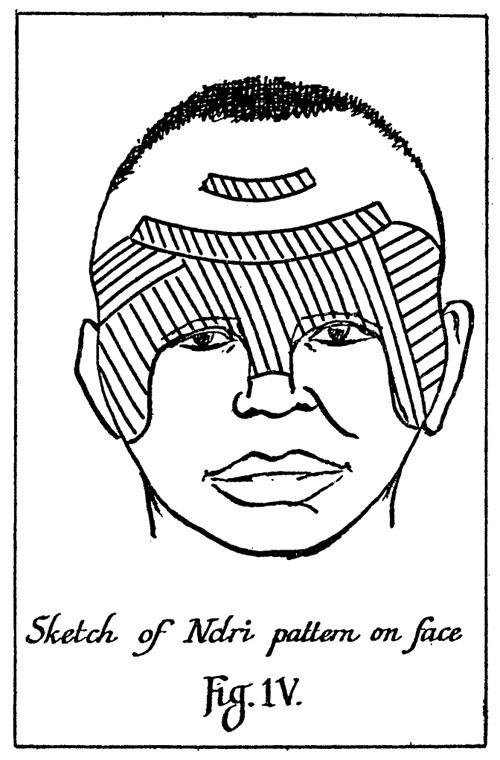
[Ichi] scarification is not a tribal mark, but a sign of status, rank, or nobility. It was taboo for persons thus marked to perform any menial task, such as to carry a load on the head; their persons were privileged and sacrosanct and they were never molested. It was also customary for the local native police, if sent to apprehend such a person, never to handcuff him.

In [ichi] scarification no attempt is made to raise keloid scars. The patient is placed supine on the ground and then, with a sharp-pointed, leaf-blade knife, strips of skin are gouged out, leaving long, raw furrows to heal. The operation is a severe test of courage and endurance and may take as long as an hour and a half to complete; it is sometimes followed by grave sepsis involving loss of sight and even of life. The victim, whether adult or child, must not wince or whimper or utter a sound.


Location: Nri, Alaigbo | Date: 1951 | Credit: M. D. W. Jeffreys

Sunday, February 27, 2011

Ibini Ukpabi


The approach to the Long Ju-Ju is through dense bush, which gradually becomes thicker and thicker until one arrives at the entrance of a deep oval-shaped pit, seventy feet deep, sixty yards long, and fifty yards wide. One then climbs down the precipitous sides of the rock into a narrow gorge and into running water, up which one wades, passing under two fences, until one finally comes to a place where the water comes out of the solid rock in two big streams, which unite below a small island, on which are two altars, one made of many trade guns, stuck muzzle downwards into the ground and topped with skulls, the other being of wood and supporting more skulls, bones, feathers, blood, eggs, and other votive offerings to the Ju-Ju, including the head of the last victim. Over the rock, where is the source of the water, is a roof of human skulls with a curtain, the top part of which is composed of clothes and the lower part of native matting, screening the rock and hanging just short of the water's edge. The lower portions of the rock composing the other side of this crater are draped with mats only. On the left of the entrance, centrally situated, and opposite the island, has been hewn out of the rock a flat-topped ledge for sacrificial purposes. The water, about twelve inches deep, is full of tame grey-coloured fish, about two feet in length, with long suckers and glaring yellow eyes, which have a most bizarre appearance as they glide noiselessly through the clear water in the dim light of this charnel-house of fetish lore, which is roofed with densely intertwined creepers. These fish are regarded as sacred. On the left of the exit lies another pile of human skulls and other relics of Ju-Ju rites, and on the left the last sacrifice--a white goat, trussed up in the branches of a palm tree and starving to death. The conducting of a visitor to the Ju-Ju is usually a somewhat lengthy process, and when he arrives in its proximity he is led by a circuitous route and finally marched in backwards. It would seem to be a fair estimate to put the number of pilgrims down at about five hundred annually, all of whom pay dearly for the advice or decree which is vouchsafed to them. Probably the number of human sacrifices does not reach a total of fifty per annum, while about 200 people are sold into slavery, and the remainder are allowed to go away free.


— Reuter, Daily Graphic

Location: Ibini Ukpabi, Arochukwu, Aro, Alaigbo | Date: 1902 | Credit: Reuter from a member of the Aro Field Force