Original

Igbo names and spellings for various settlements
Abakaliki is Abankaleke; Afikpo is Ehugbo; Awgu is Ogu; Awka is Oka; Bonny is Ubani; Enugu is Enugwu; Ibusa is Igbuzö; Igrita is Igwuruta; Oguta is Ugwuta; Onitsha is Onicha; Owerri is Owere; Oyigbo is Obigbo... any more will be added.
Showing posts with label 1950s. Show all posts

Tuesday, May 12, 2020

Prince Chukwuma of Àbọ, William Baikie

"Prince Tshúkuma [Chukwuma]" of Abö, illustration from an 1854 voyage by William Baikie. Internet Archive.
[At Abö] we learnt that King Obí [Osai] had been dead for nearly nine years, and that since that time there had been no regular king. At Abó, the chief power is elective, and after the death of Obí two parties sprung up, one of which supported the claims of his son, while the other advanced as their candidate an influential person named Orísa. The two sections were respectively entitled the king's people and the Oshiodápara party. Obí's friends were unanimous in their selection of Obí's second son, named Ajé, an active, intelligent, young man ; and this was acquiesced in by his less energetic and more peaceful brother Okúrobi or Tshúkuma.

Sunday, March 3, 2019

The significance of Igbo groups in the Ibo Union, c. 1958.

Photo: Diobu Ikwere leaders protesting the 1958 (Willink) Minorities Commission (probably protesting the decision not to create a Rivers State and other states considered 'minority' states outside of the larger ethnic groups like the Igbo). August 27, 1958. National Archives UK.
Among the Ibo, as among other Nigerian nationalities, numerous tribal sections and sub-sections have their particular customs and traditions which inspire local or sectional loyalties. The Nnewi, the Mba-ise, the Ohafia, the Ngwa, the Ikwerri, etc., exemplify that remarkable "strength of Ibo clan feeling"' which sustains the vigor of the ubiquitous Ibo improvement associations and the enthusiasm with which programs of community development based on voluntary communal labor have been pursued. …
While the Ibo State Executive has not been amenable to facile manipulation by the NCNC leadership, the lower echelons of the Union—i.e., the town, village, district, and clan unions—work virtually without direction to identify the NCNC with the cause of Ibo welfare. In many instances, town and clan unions affiliated with the Ibo State Union have made up for the organizational failings of the official party organization. For example, the ground swell of mass support for Azikiwe in the summer of 1958, during his struggle with Dr. Mbadiwe, was generated largely by local units of the Ibo State Union. In addition, certain branches of the party, including the strong NCNC organization in Port Harcourt, derive their strength from sub-nationality associations affiliated with the Ibo State Union.
[In notes:] In 1958 numerous ethnic group associations affiliated with the Port Harcourt Ibo Union were represented informally within the official structure of the Port Harcourt NCNC by influential members of the branch executive committee and the executive committee of the Port Harcourt NCNC Youth Association. Among them were the following: the Nnewi Patriotic Union, the Orlu Divisional Union, the Orlu Youth League, the Oguta Union, the Owerri Divisional Union, the Mbasi Clan Union, the Bende Divisional Union, the Ikwerri Development Union, the Okigwe Union, and the Abiriba Improvement Union. The Ibo Union of Port Harcourt, comprising representatives of these and other Ibo associations, co-ordinates certain of the activities of its affiliates but has no power of direction over them. It does not constitute an effective alternative power structure to the NCNC branch, inasmuch as the latter draws its popular support directly from the people and indirectly from their sub-nationality associations.

– Robert L. Sklar (1963). “Nigerian Political Parties: Power in an Emergent African Nation.” pp. 147, 463.

Monday, September 10, 2018

The Ibo State Union

Endowment Fund. Ibo National High Schools. Ibo State Union Headquarters. 1954.

The Ibo State Union was the main pan-ethnic Igbo organisation from 1948-1966. It started out as the Ibo Federal Union founded in 1944 by the leaders of the Lagos Ibo Union.

In 1943, Dennis Chukude Osadebay, the general secretary of the Ibo Union in Lagos who represented the Asaba Union, launched a campaign to federate all Igbo unions throughout Nigeria resulting in the formation of the Ibo Federal Union in 1944 which later became the Ibo State Union.

The Ibo State Union's goal was for solidarity among the Igbo people as well as support for educational development. Formed by elite Igbo nationalists, the union also functioned as an anti-colonial and nation-building organisation and supported an agenda for Nigerian independence.

The Ibo Federal Union, once headed by Nnamdi Azikiwe and renamed the Ibo State Union in 1948, produced an Igbo national anthem and once planned for a national bank of Igboland. The union also made the 6th November 'Ibo National Day.' The union was close with the NCNC.

The Ibo Federal Union became the Ibo State Union at a 1948 pan-Igbo conference at Aba in order “to organize the Ibo linguistic group into a political unit in accordance with the NCNC Freedom Charter.”

The Ibo State Union was banned in 1966 along with other political parties by the Aguiyi-Ironsi regime through decree 34 of May 24. During its existence, the Ibo State Union was one of the most influential ethnic organisations in Nigeria.
Friday, July 27, 2012

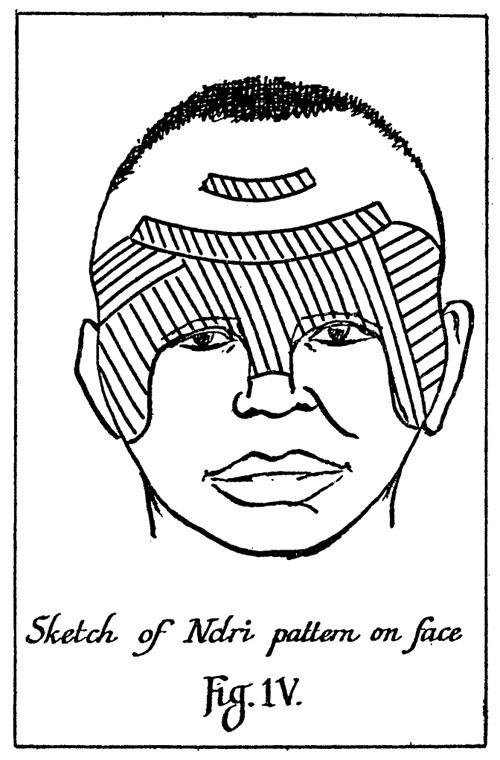
[Ichi] scarification is not a tribal mark, but a sign of status, rank, or nobility. It was taboo for persons thus marked to perform any menial task, such as to carry a load on the head; their persons were privileged and sacrosanct and they were never molested. It was also customary for the local native police, if sent to apprehend such a person, never to handcuff him.

In [ichi] scarification no attempt is made to raise keloid scars. The patient is placed supine on the ground and then, with a sharp-pointed, leaf-blade knife, strips of skin are gouged out, leaving long, raw furrows to heal. The operation is a severe test of courage and endurance and may take as long as an hour and a half to complete; it is sometimes followed by grave sepsis involving loss of sight and even of life. The victim, whether adult or child, must not wince or whimper or utter a sound.


Location: Nri, Alaigbo | Date: 1951 | Credit: M. D. W. Jeffreys